Where Was Christopher Nolan’s ‘The Odyssey’ Filmed? Every Real Location Behind the Epic
Christopher Nolan did not approach The Odyssey as a story that could be contained inside one studio complex. Homer’s poem moves from palaces and battle-scarred cities to volcanic islands, enchanted forests, caves and the edge of the Underworld. Nolan’s film follows the same restless course, assembling its ancient world from landscapes spread across Europe, North…
Christopher Nolan did not approach The Odyssey as a story that could be contained inside one studio complex. Homer’s poem moves from palaces and battle-scarred cities to volcanic islands, enchanted forests, caves and the edge of the Underworld. Nolan’s film follows the same restless course, assembling its ancient world from landscapes spread across Europe, North Africa and the United States.
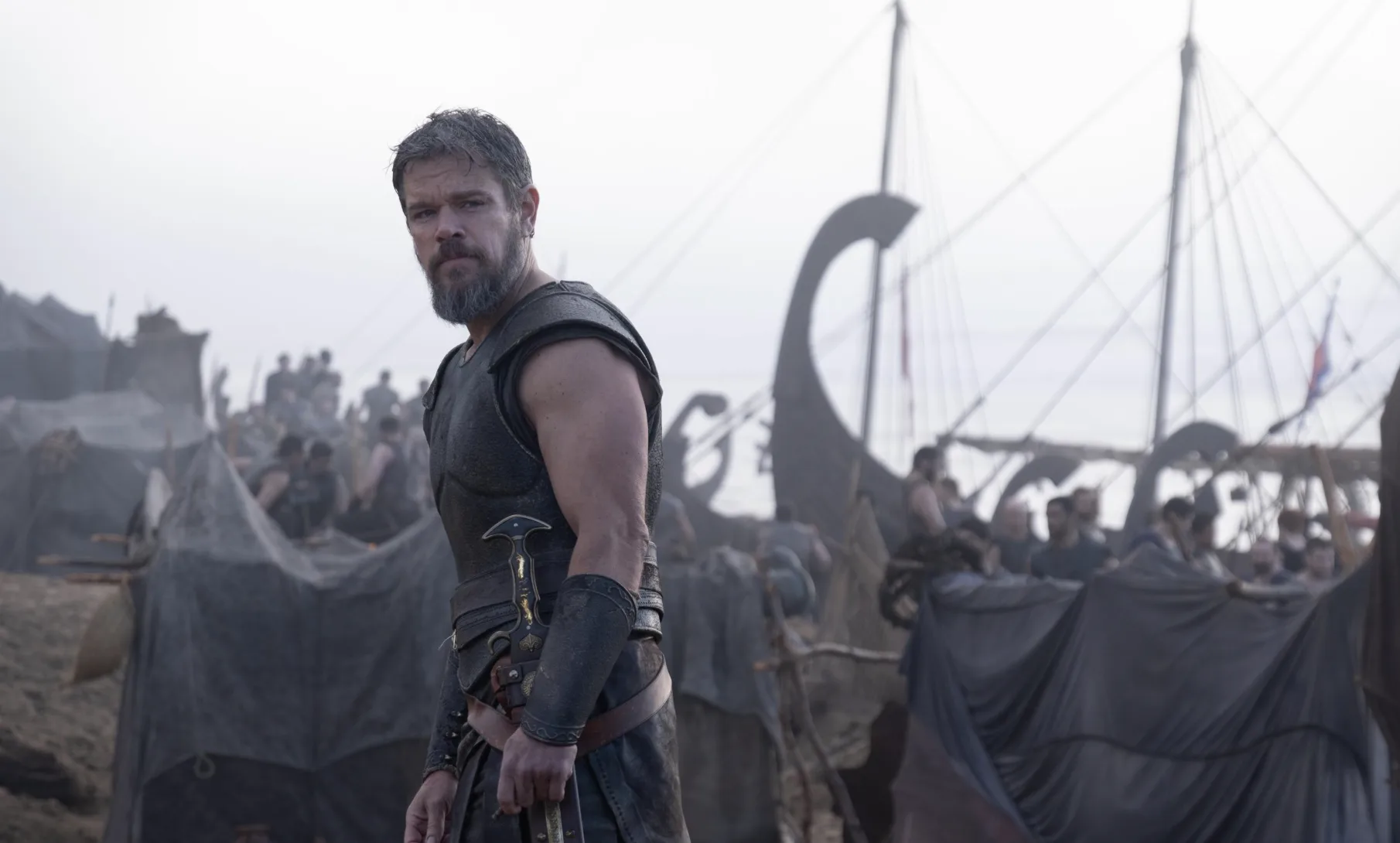
Matt Damon’s Odysseus begins his return from Troy believing that Ithaca lies within reach. Instead, the voyage becomes a test of endurance involving gods, monsters, storms and temptations. The production followed an expeditionary path of its own. According to production designer Ruth De Jong, the principal shoot covered six countries: Morocco, Greece, Italy, Iceland, Scotland and the United States over 91 filming days. The schedule was difficult by design: real ships went to sea, performers entered genuine caves, temporary cities were built against historic settlements and palace sets were constructed at a scale rarely attempted for a contemporary studio film.
The resulting geography is deliberately imaginative. Nolan was not trying to produce a literal map of Odysseus’ Mediterranean route. Morocco becomes Troy and Calypso’s remote island. Sicily stands in for Ithaca. Iceland supplies Hades. Northern Scotland transforms into Circe’s domain. Los Angeles completes spaces that could not be controlled safely or practically in the open landscape.
The Odyssey Filming Locations
The six principal production countries were Morocco, Greece, Italy, Iceland, Scotland and the United States. Within those countries, filming reached Aït Benhaddou, Essaouira, Dakhla, the Peloponnese, Favignana, the Aeolian Islands, Hjörleifshöfði, the Moray coast and Universal’s Los Angeles facilities.
That six-country figure comes directly from De Jong’s account of the production. Online totals sometimes rise to seven or eight because Malta has been connected to supplementary tank photography, while Norway supplied the large wooden vessel used as Odysseus’ ship. Neither country appears in De Jong’s principal-location tally, and no substantial dramatic sequence has been reliably identified as having been photographed in Norway. Malta and Norway therefore require a different label from the six principal shooting countries.
Morocco and Moroccan-administered Western Sahara
Aït Benhaddou
The strongest visual foundation for Troy came from Aït Benhaddou, the fortified earthen settlement in Morocco’s Ouarzazate province. Rather than conceal the historic village behind a digitally created city, De Jong’s department used its walls and clustered mud-brick buildings as the central layer of Troy.
The crew then expanded that silhouette with approximately two and a half acres of temporary construction. New gates, towers, stairs and religious structures were positioned against the existing settlement, allowing the camera to move through a city that appeared much larger than the practical build. Some additions were engineered to burn during the fall of Troy, while the protected historic fabric remained untouched.
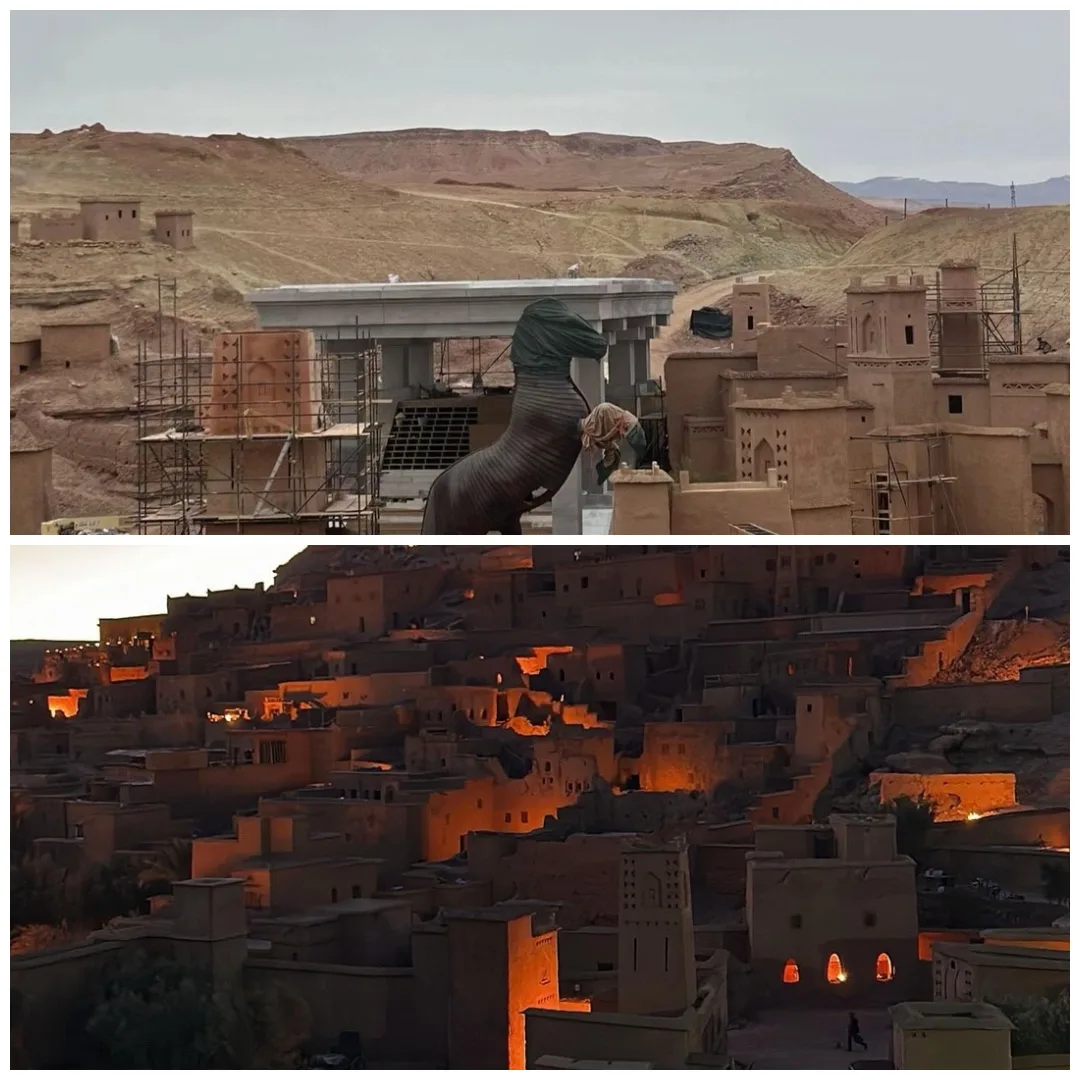
That distinction matters. Aït Benhaddou was not merely photographed in the distance as a picturesque background. It provided the spatial logic of the city: elevated walls, constricted approaches, irregular rooflines and a natural connection to the surrounding desert. The construction department supplied what the story required, but the Moroccan landscape gave the sequence its scale and physical credibility.
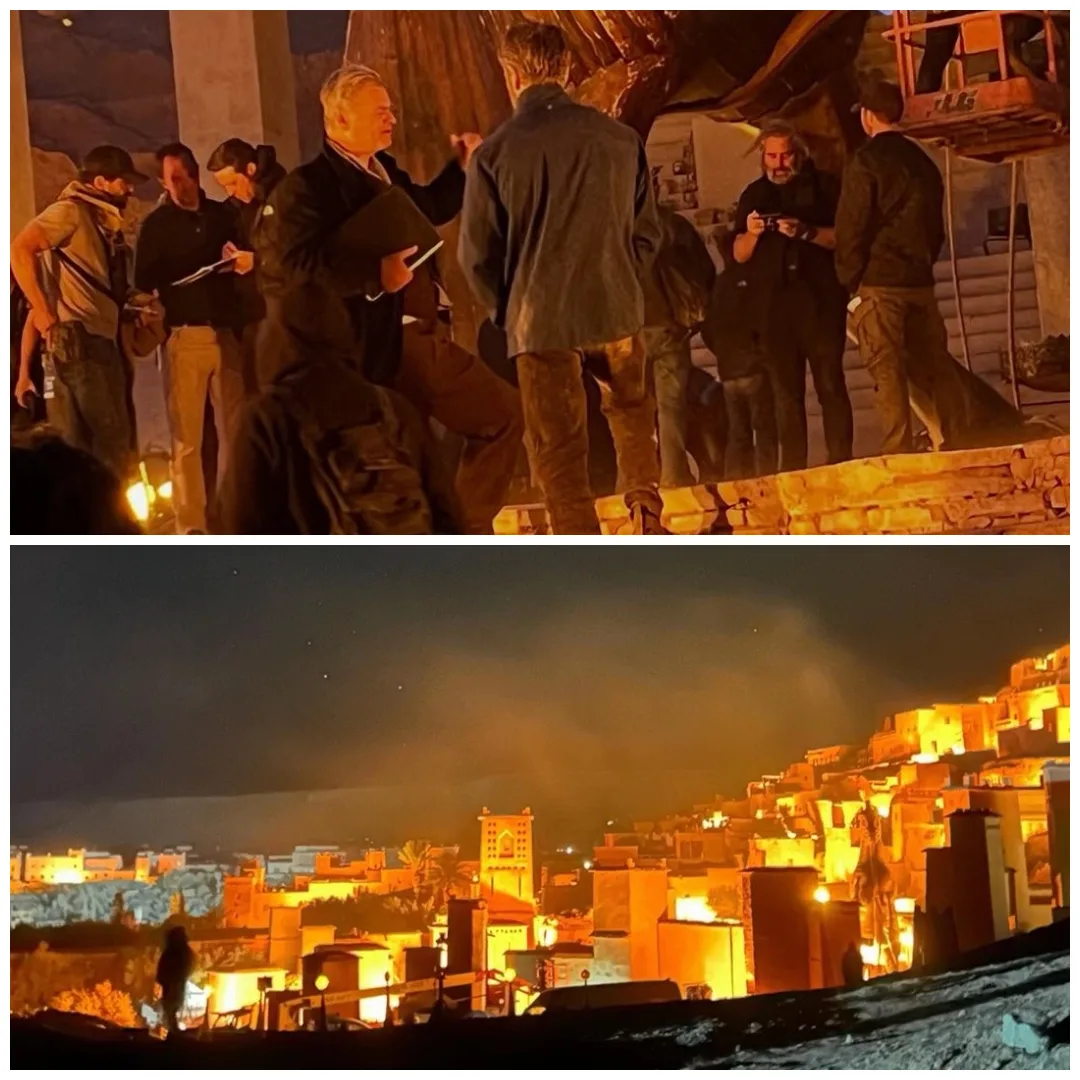
Production also moved through Tahanaout and the wider El Haouz region, southwest of Marrakech. Post-release comparisons associate some of that material with approaches to Troy and its surrounding settlement, although De Jong’s detailed account identifies Aït Benhaddou as the principal Trojan city. Tahanaout should therefore be recorded as part of the Morocco unit without overstating which individual streets survived into the final cut.
Essaouira
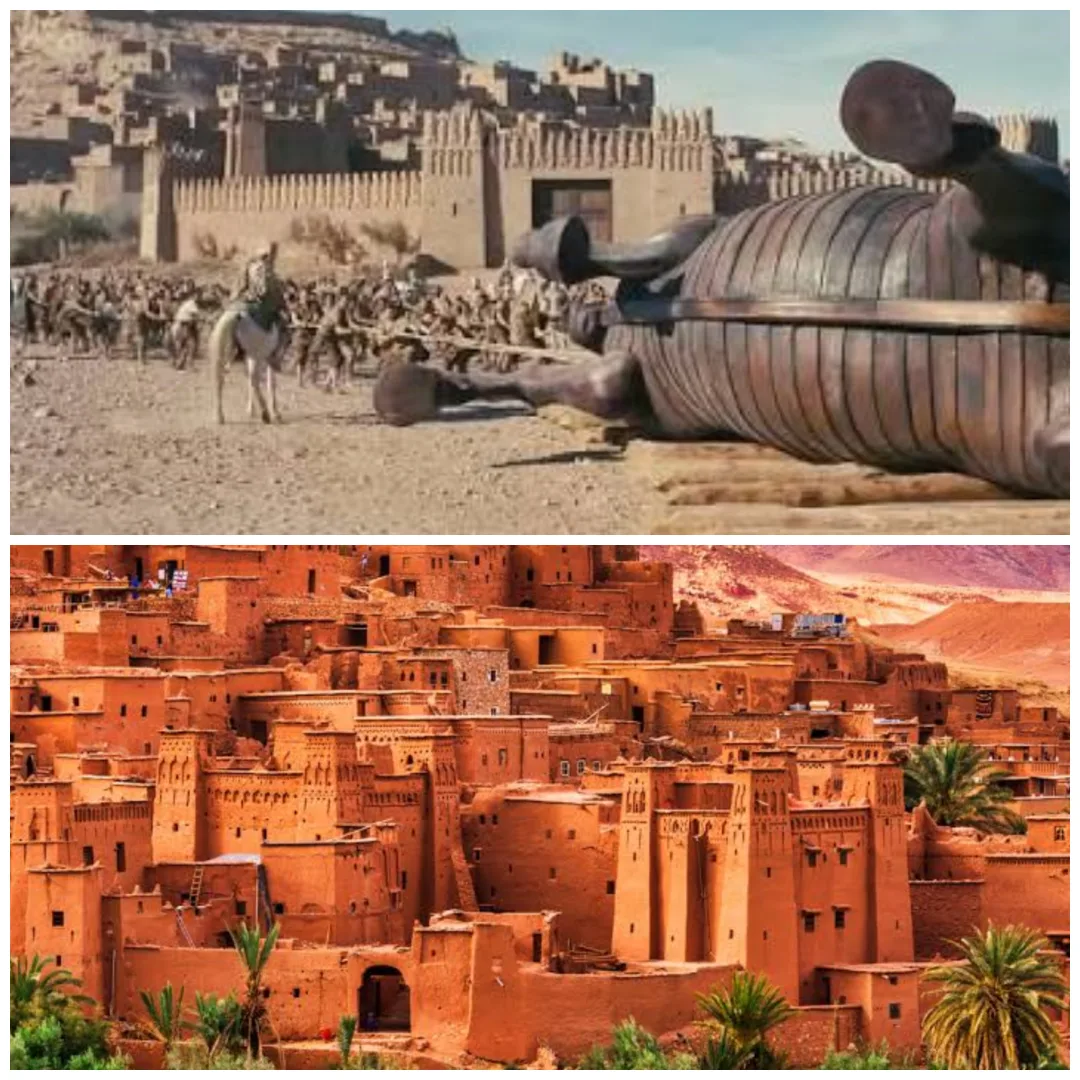
The discovery of the Trojan Horse was filmed on the Atlantic shoreline at Essaouira. The same coastal area was used when Odysseus and his surviving men launched their ships and began the journey home.
The horse was not a lightweight object added later through computer imagery. It was designed and fabricated in Los Angeles, shipped to Morocco and installed on the beach. The approximately 35-foot structure could accommodate performers and was positioned partly in the water for the discovery material. This allowed the actors, soldiers and ships to occupy the same physical environment rather than being assembled from unrelated elements.
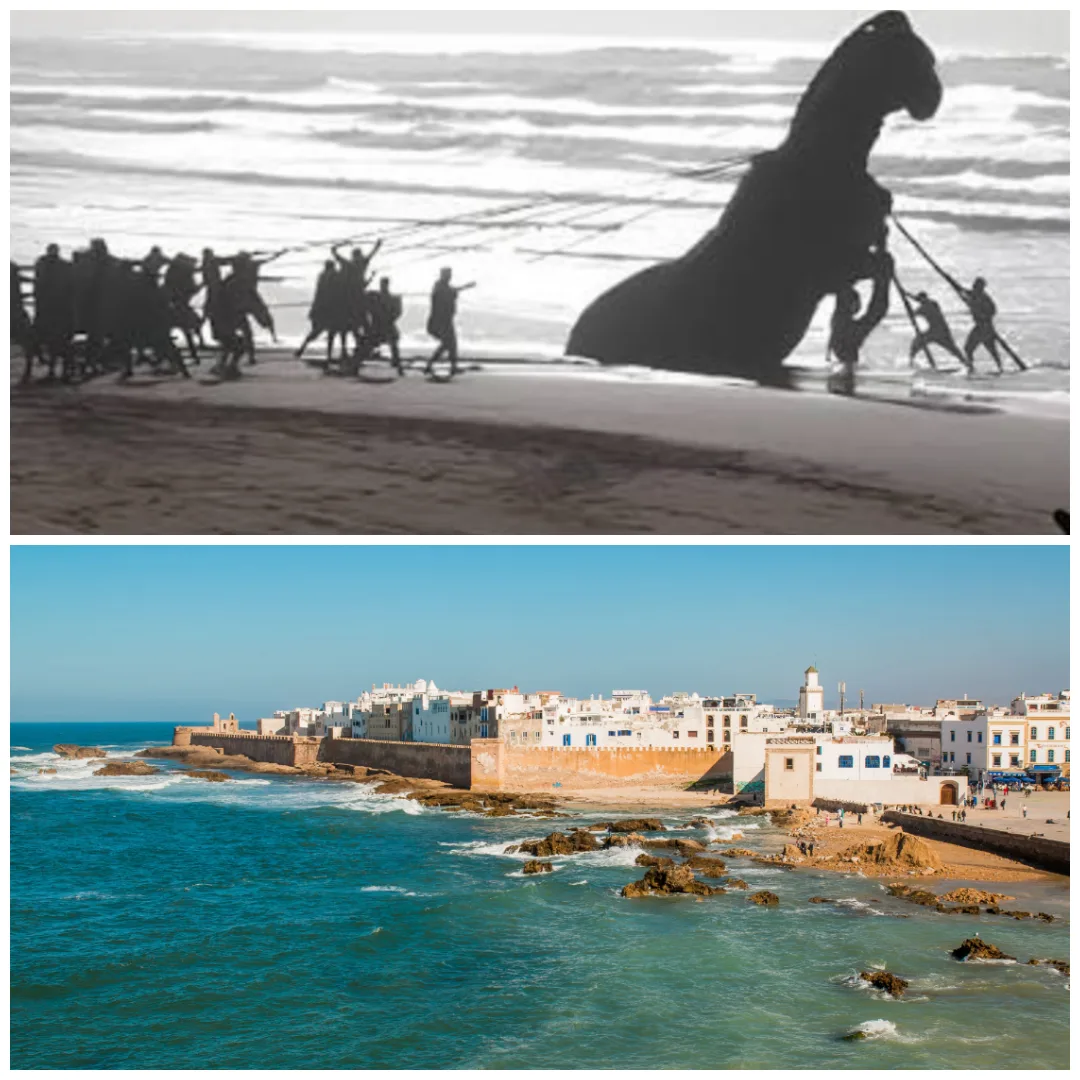
Essaouira also gives the departure an important change of texture. Aït Benhaddou’s enclosed walls represent the violent conclusion of the war; the open Atlantic creates the deceptive promise of freedom. The men have escaped Troy, yet the unprotected horizon already suggests that their greater ordeal has only begun.
Marrakech
Telemachus’ search for news of his father leads him to the court of Menelaus and Helen. Nolan created this palace from locations in two countries rather than relying on one complete historic building.
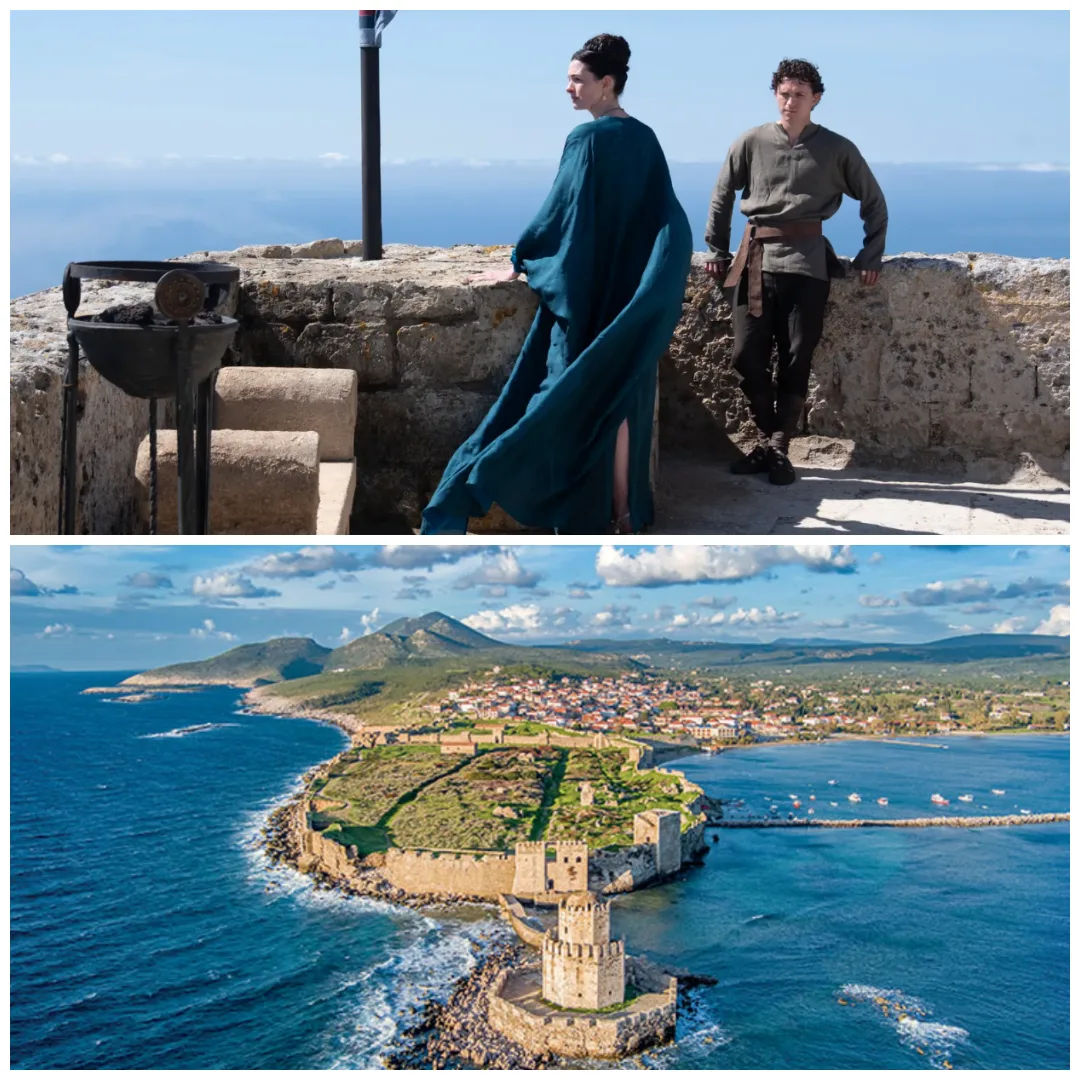
The exterior royal setting was photographed around Methoni Castle in Greece, particularly the fortified Bourtzi structure reached by a stone causeway. An unnamed interior discovered during the Morocco scout in Marrakech supplied palace material that required a more enclosed and decorative environment. The two locations are edited as parts of the same ancient court.
Dakhla
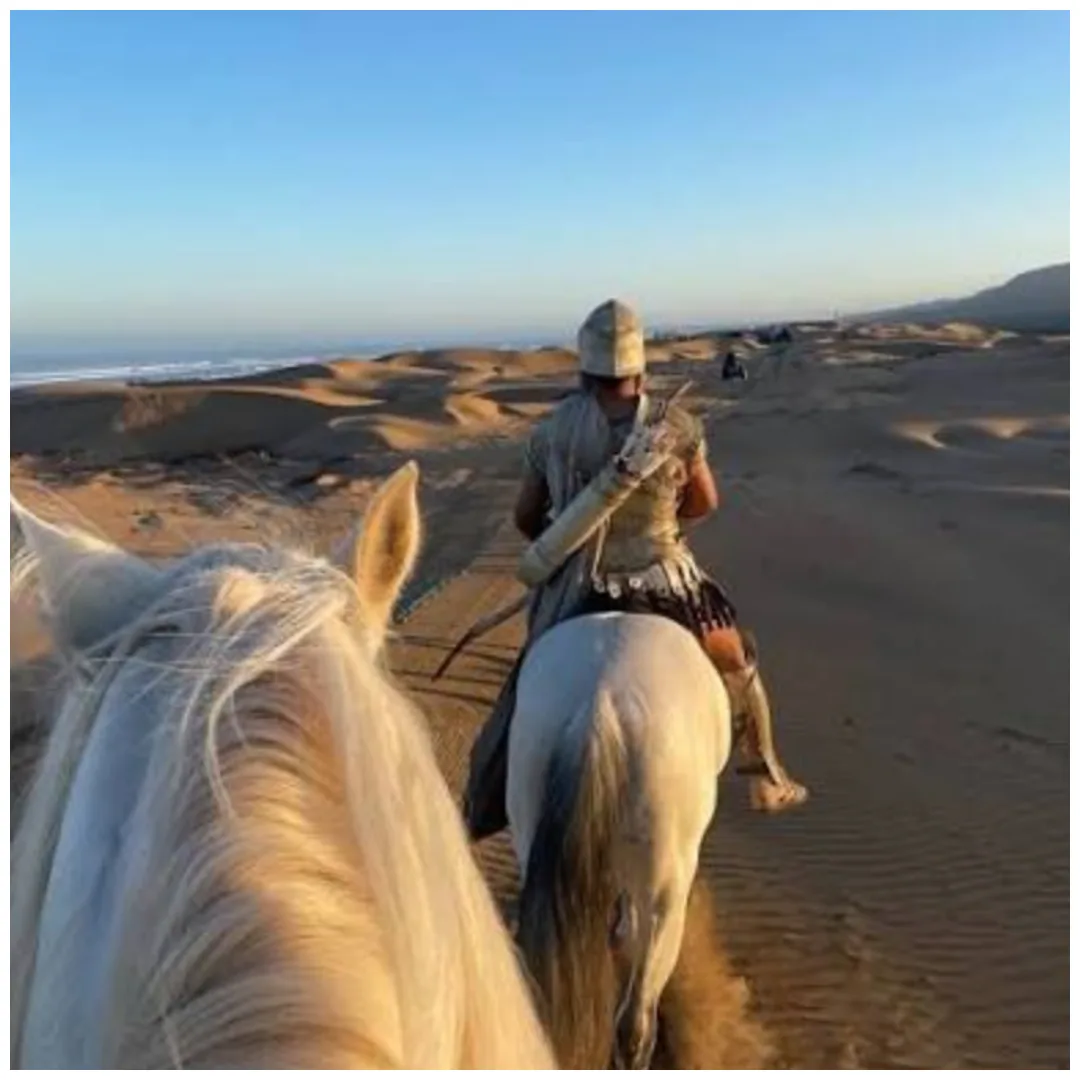
Calypso’s isolated island, Ogygia, was created on the Atlantic coast near Dakhla, principally around Dune Blanche, or the White Dune. The site rises from a lagoon-like coastal landscape in the far south of Moroccan-administered Western Sahara. Its pale sand, shallow water, wind and immense horizon produce a setting that is inviting at first glance but psychologically inescapable.
Greece
Peloponnese, Messinia
The Greek section of the production was concentrated in the Peloponnese, particularly Messinia, with additional work at Acrocorinth. The Hellenic Film Commission confirms five principal sites: Nestor’s Cave, Voidokilia Beach, Almyrolaka Beach, Methoni Castle and Acrocorinth. Filming permits covered March and April 2025.
Greece gives the film a direct physical connection to the culture from which the poem emerged, but Nolan uses those locations selectively. They do not represent every Greek or Homeric place. Instead, individual landscapes were chosen for their dramatic shape: a nearly enclosed bay, a naturally oppressive cave, a sea fortress and an acropolis rising above a broad plain.
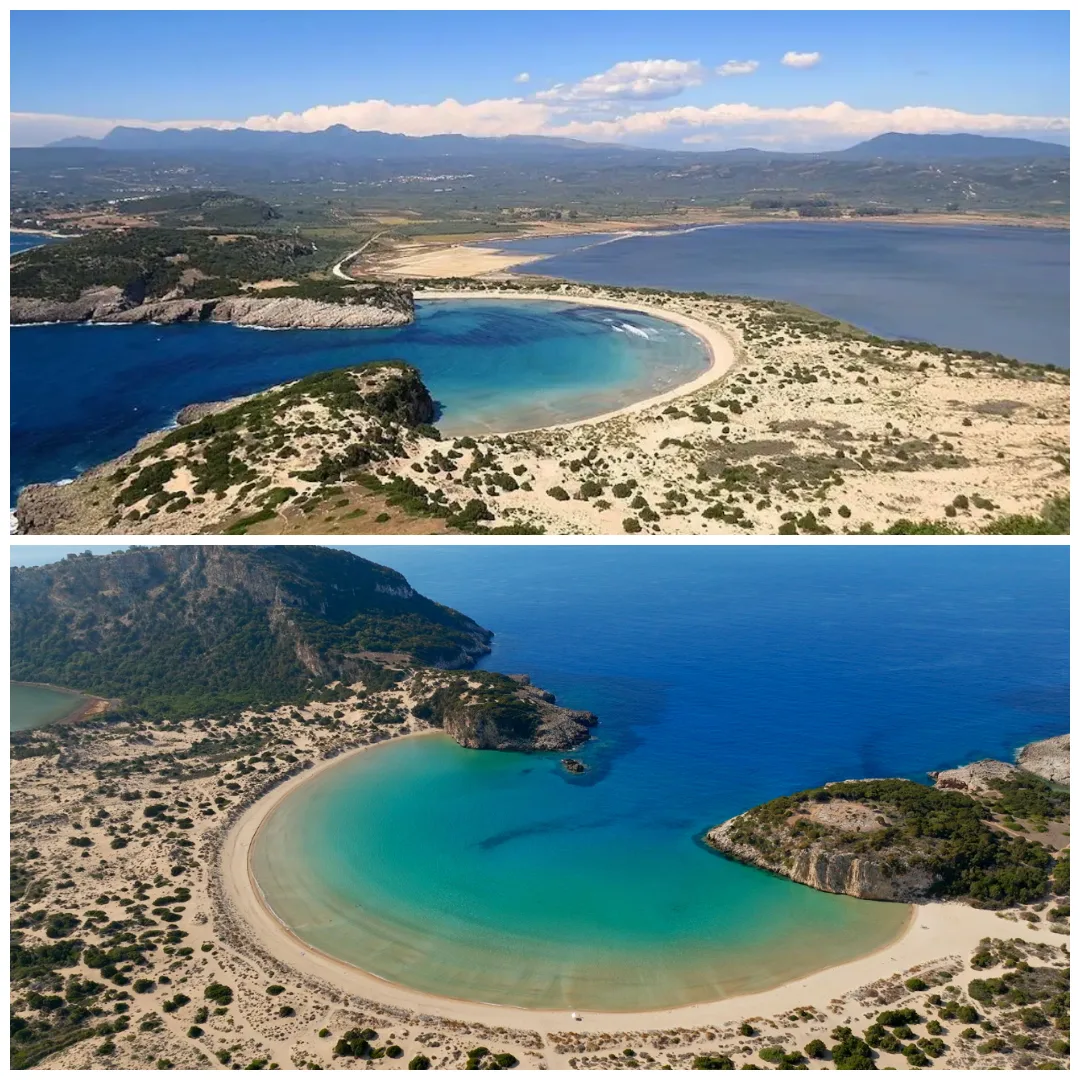
Voidokilia Beach
Odysseus’ encounter with Polyphemus begins along Voidokilia Beach, near Pylos. The beach’s near-perfect crescent creates a deceptive calm, making it an effective landing place for men who do not yet understand the danger awaiting them inland.
The cave itself is Nestor’s Cave, positioned in the hillside above the bay. Nolan could have constructed a cavern with removable walls, predictable lighting and easy access for equipment. Instead, the company brought performers, camera gear, animals and practical set elements into the real cave. Once the entrance was blocked for the scene, the uneven rock and restricted darkness gave the sequence a physical oppression that would have been difficult to reproduce on a stage.
Voidokilia and Nestor’s Cave consequently function as one continuous location in the movie: the inviting shore on which the men arrive and the interior trap from which they must escape. The nearby Almyrolaka Beach is also officially confirmed by the Hellenic Film Commission, although the production has not provided a definitive public breakdown of its exact final-cut scene. It should remain in the location record without an invented assignment.
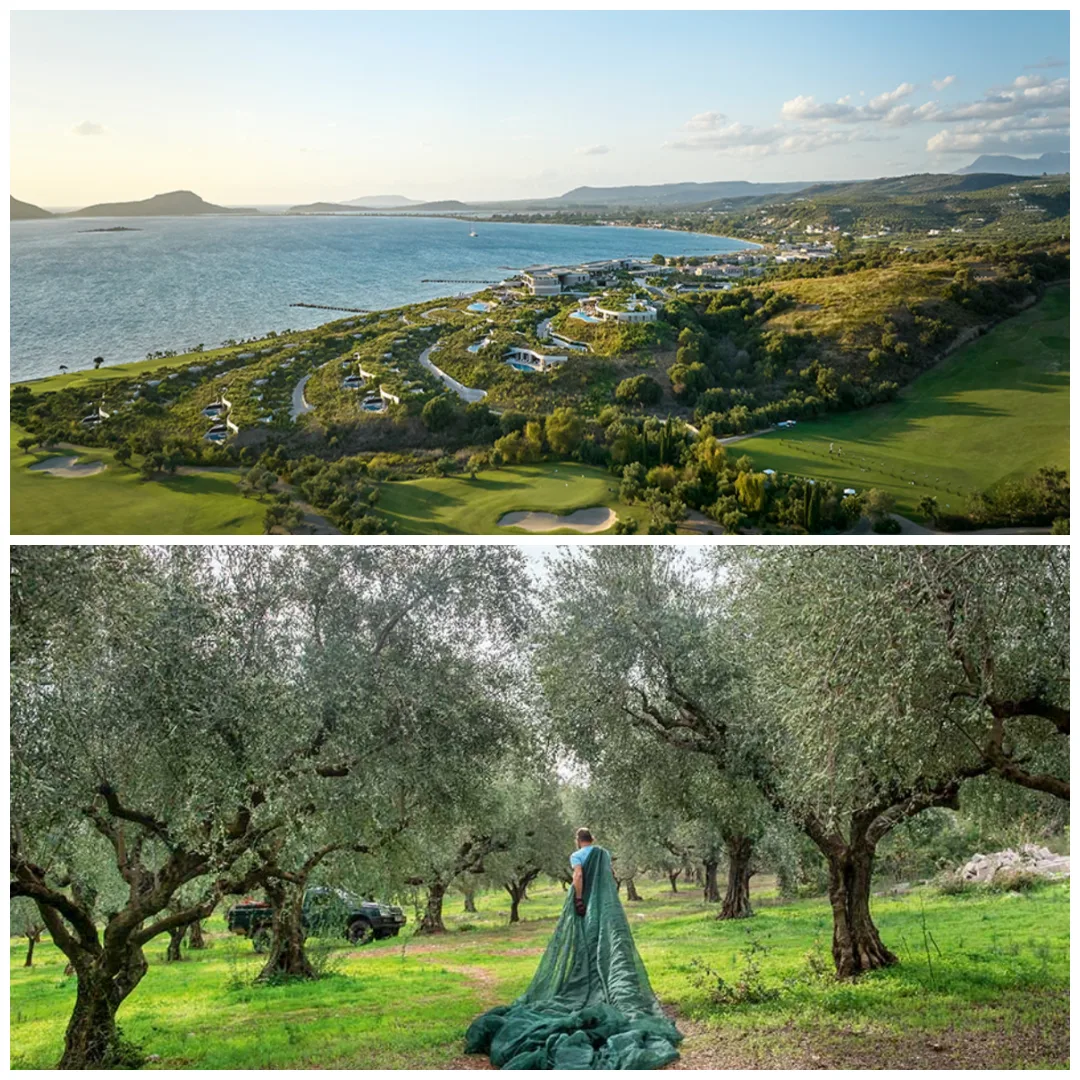
Olive Grove in Messinia
Part of Telemachus’ visit to Sparta was filmed in an olive grove in Messinia. De Jong identified the grove as the setting for a hunting sequence connected to the young man’s visit to Menelaus. The specific estate or village has not been publicly named.
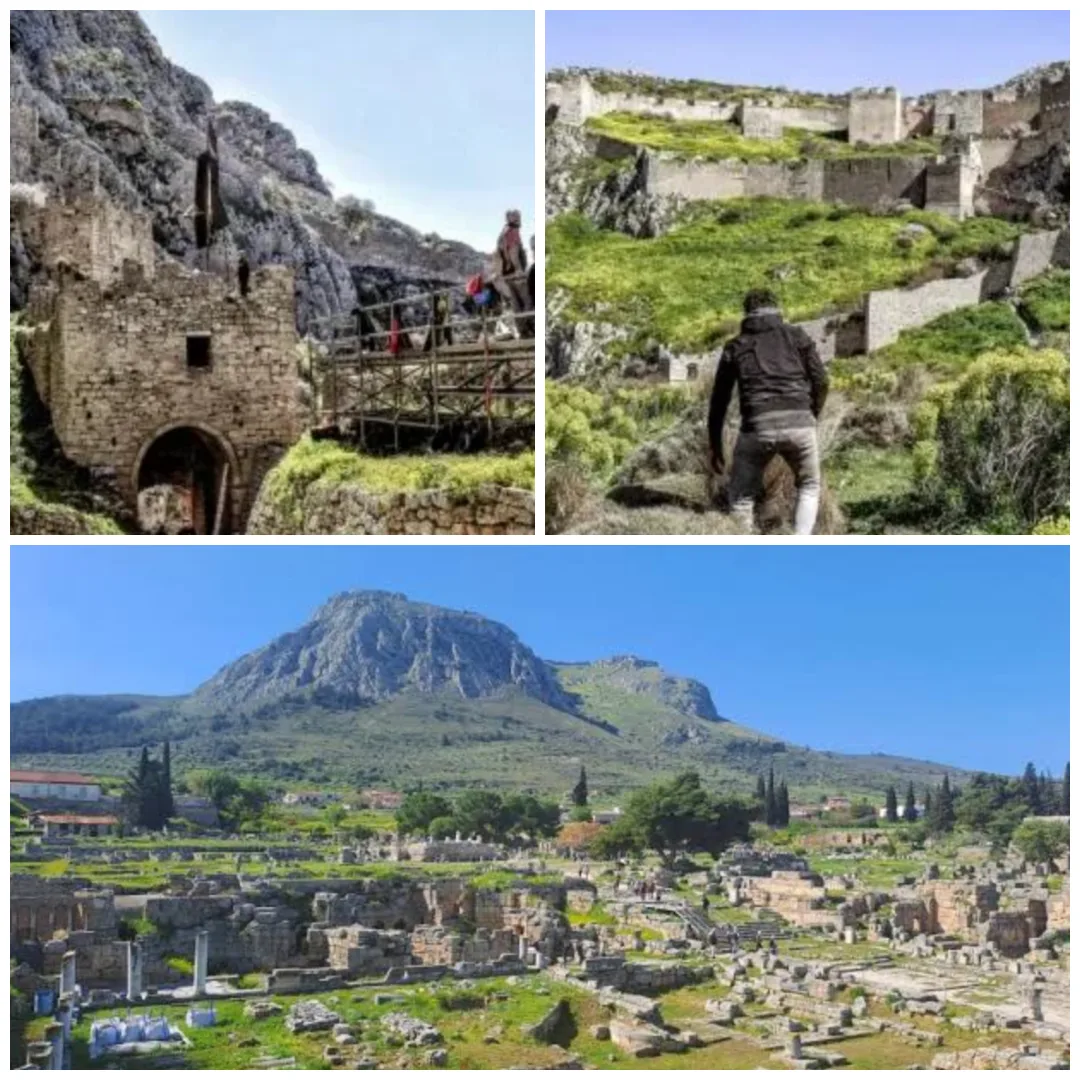
Acrocorinth
The return of Agamemnon was staged at Acrocorinth, the great fortified height above ancient Corinth. The site’s exposed slopes, monumental walls and powerful wind gave the homecoming a public, almost ritualistic character.
Favignana
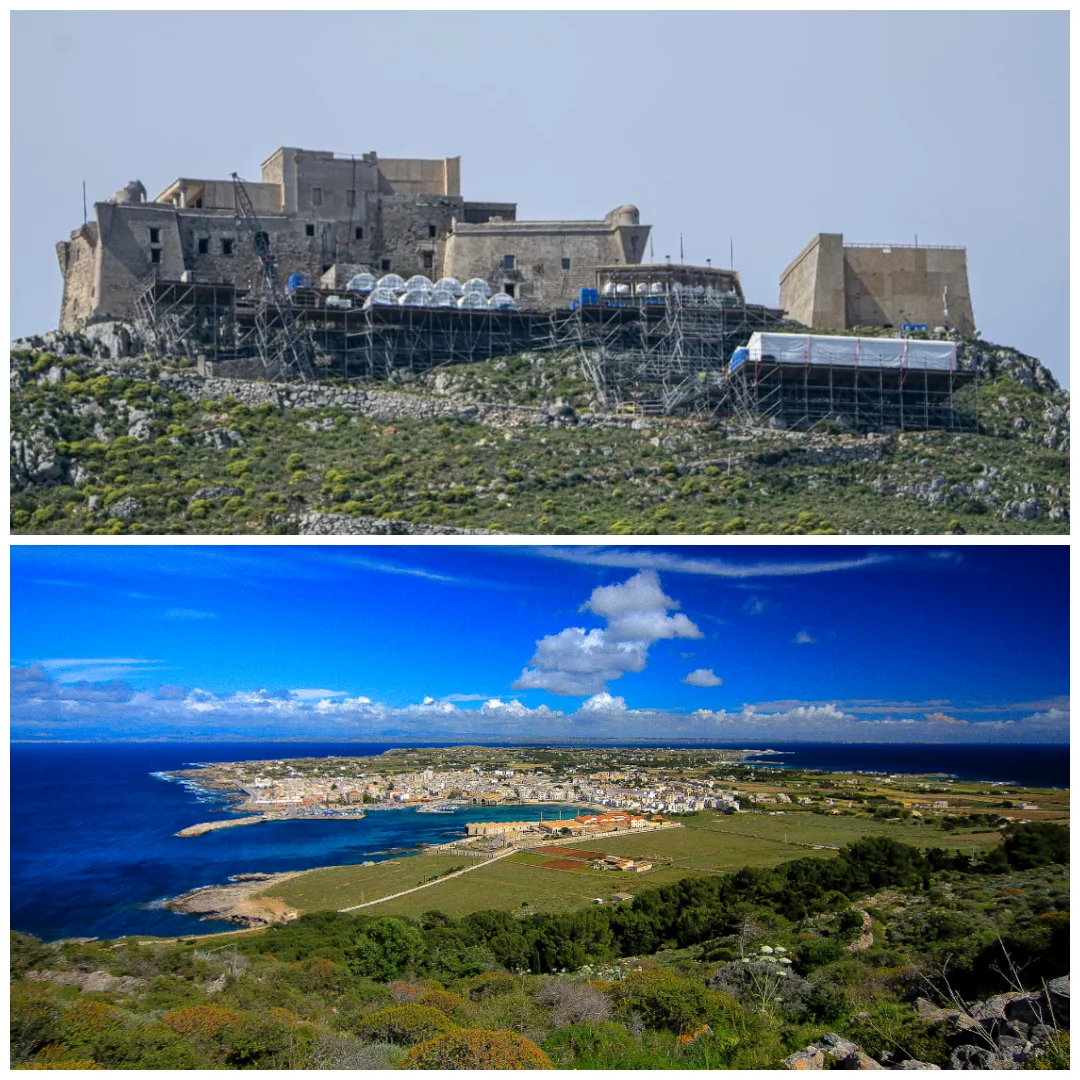
The real Greek island of Ithaca did not play Odysseus’ homeland. Nolan instead chose Favignana, one of the Egadi Islands west of Sicily, because its rugged high ground, surrounding sea and relatively quiet off-season environment could support the image of an isolated kingdom.
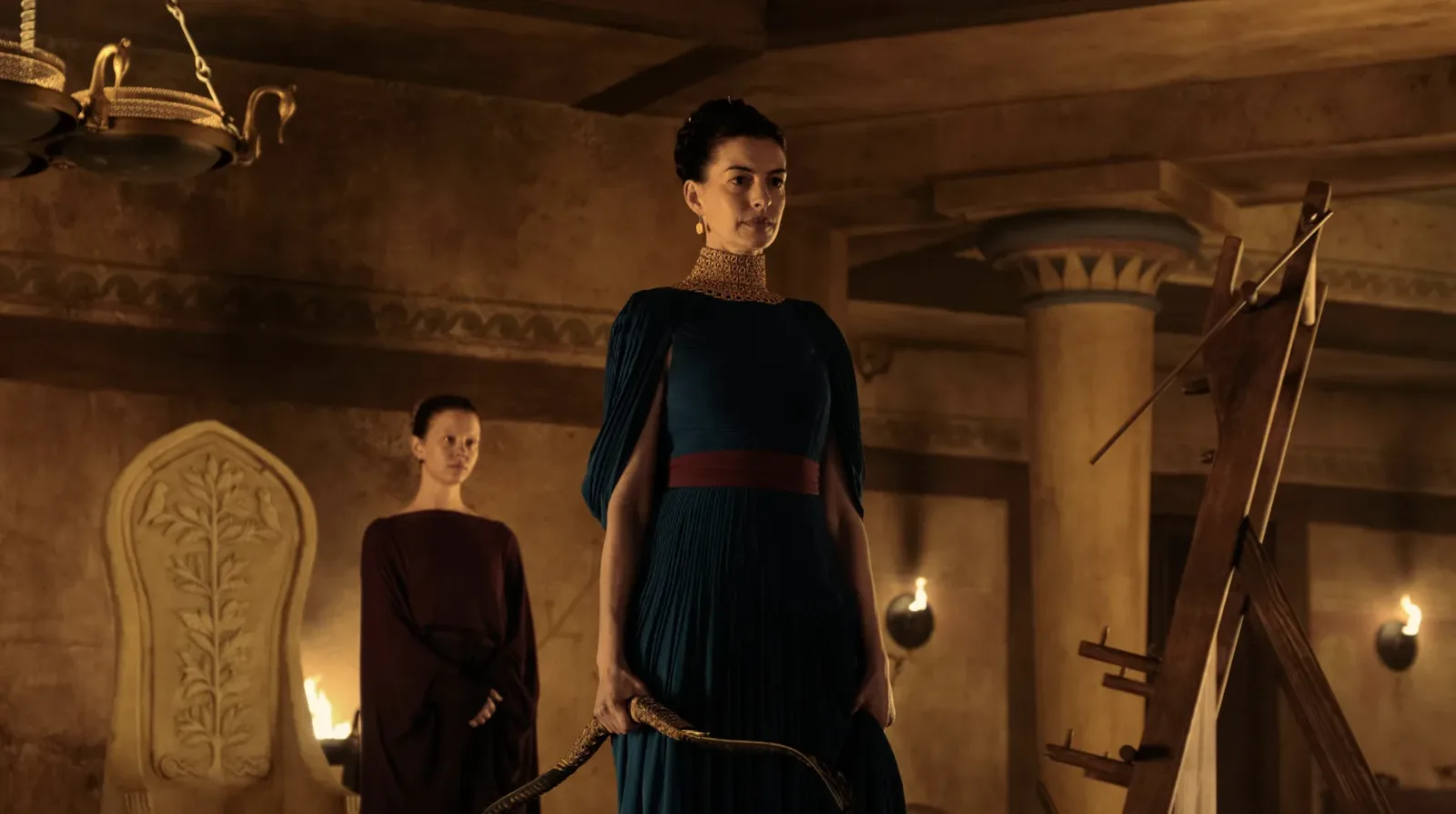
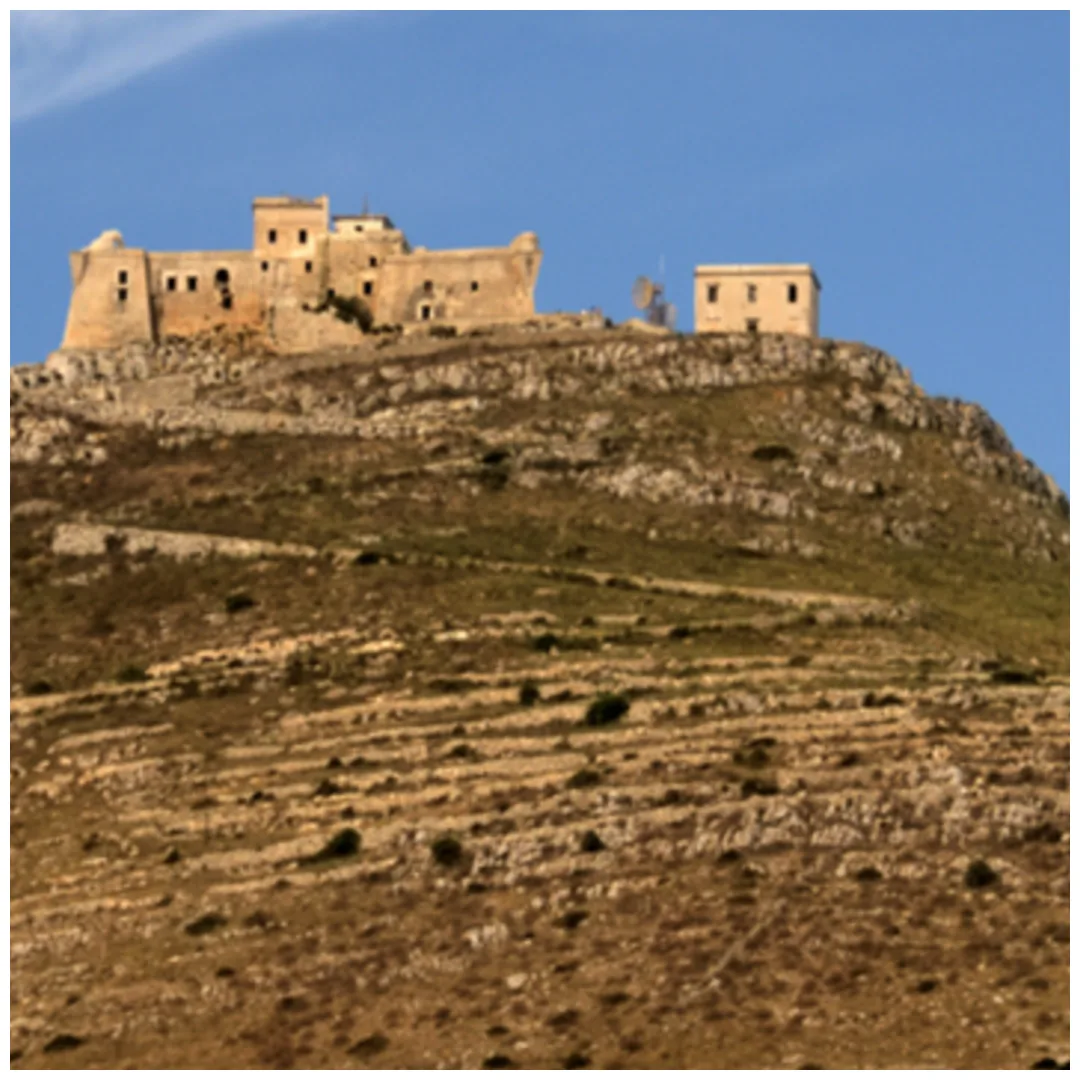
The defining landmark is Castello di Santa Caterina, the abandoned fortress at Favignana’s highest point. It became the exterior of the Ithacan royal compound where Penelope, played by Anne Hathaway, and Telemachus, played by Tom Holland, wait as Odysseus’ absence enters its final years.
Italy
Was the Ithaca Palace Real?
Only part of it. The exterior belongs to Santa Caterina and the surrounding Favignana landscape, but the principal palace interior was constructed in Los Angeles.
De Jong’s department built a three-level Ithacan megaron on a Universal soundstage. The set was reportedly approximately two football fields in length, giving Nolan room to stage the suitors, Penelope’s household and the eventual confrontation as connected pieces of one architectural space. A more specific location report identifies Stage 12 at Universal Studios, although the production designer’s account confirms the Los Angeles stage without relying on that stage number.
The palace is therefore one of the film’s most elaborate location illusions. Its exterior exists on a Sicilian summit, while its interior stands in Southern California. The transition works because both spaces were designed around the same proportions, materials and visual language.
Aeolian Islands
After Favignana, production moved to the Aeolian Islands, the volcanic chain north of Sicily. Italy’s national production-location portal confirms work around Lipari, Vulcano and Panarea, including the distinctive sea stacks off Lipari. The Italian campaign lasted approximately seven weeks in spring 2025, with the unit moving into the Aeolian section around mid-April.
These islands provide several stages of Odysseus’ voyage rather than one single destination. Their volcanic rock, abrupt cliffs and exposed channels give the sea a sense of danger even in calm weather.
Detailed post-release comparisons identify Lipari and Vulcano with Aeolia, the kingdom of the keeper of the winds. The Faraglioni di Lipari, including the towers known as Pietra Lunga and Pietra Menalda, appear in the passage through the Wandering Rocks. Their narrow channels allow the landscape itself to become an obstacle rather than a passive horizon.
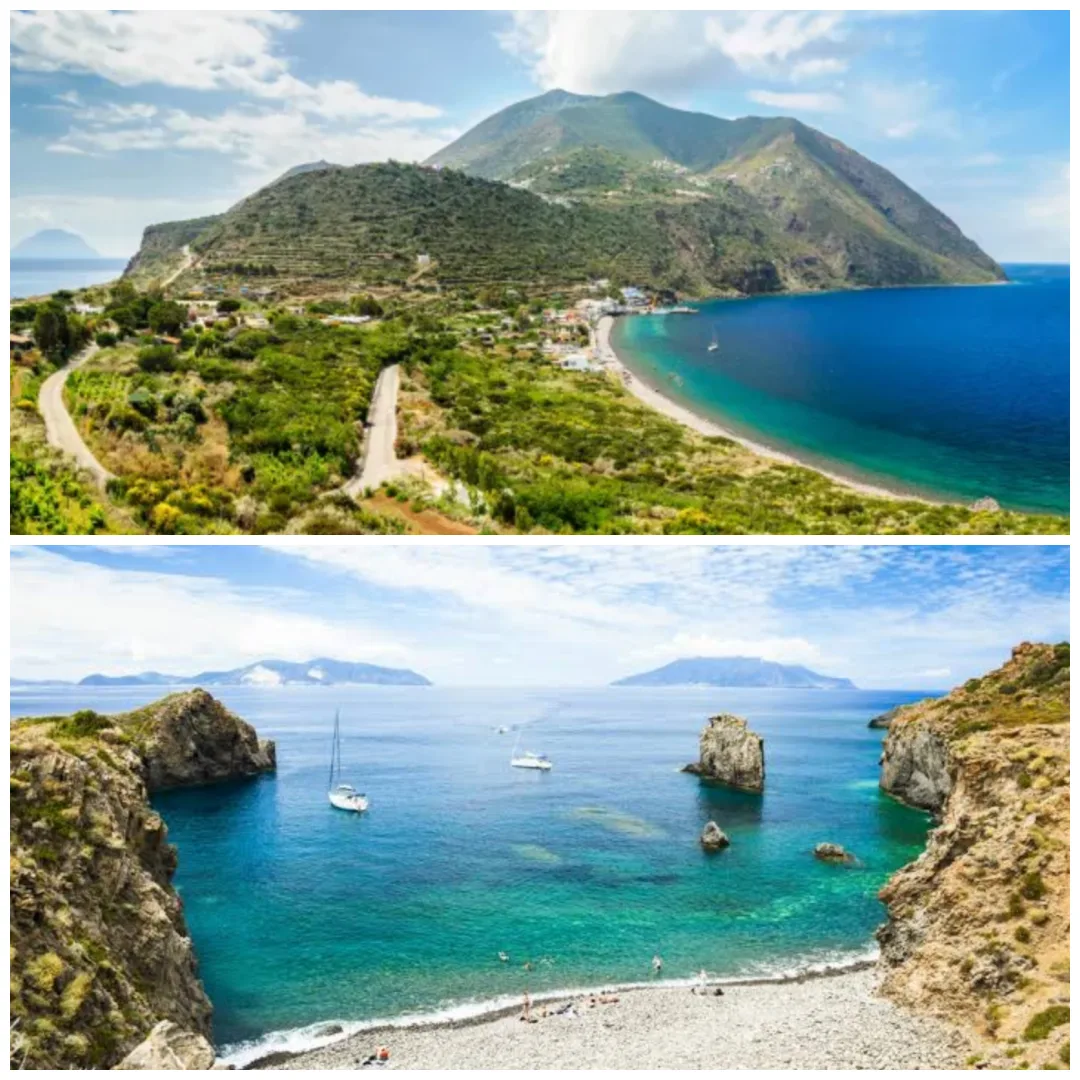
The waters around Pietra del Bagno have been matched to the Sirens sequence, while Basiluzzo and Scoglio Spinazzola, in the Panarea sector, are associated with the hazardous passage involving Scylla and Charybdis. The official Italian source confirms the production’s presence around Panarea, while the more precise rock-by-rock assignments come from post-release visual matching rather than a Universal location sheet.
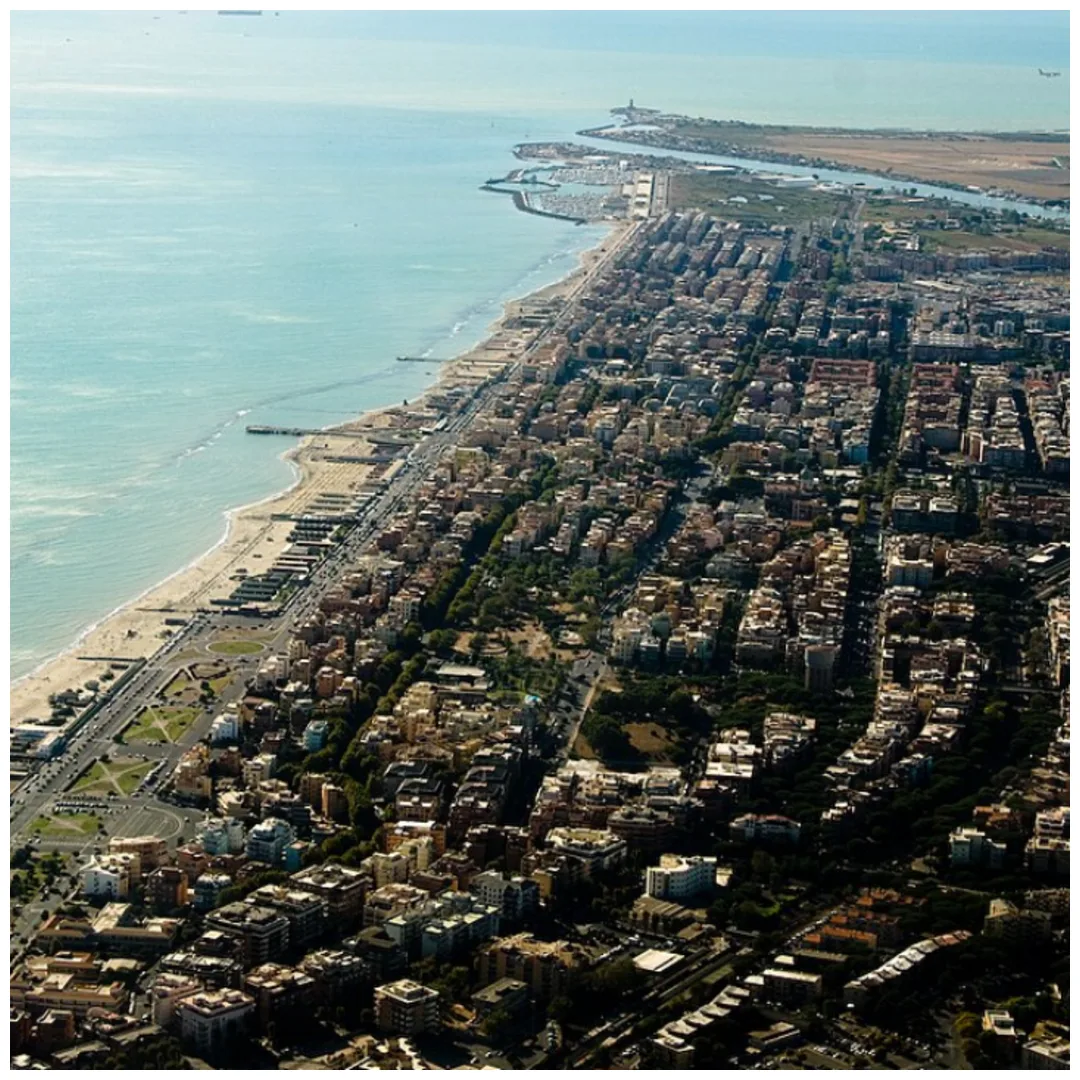
Tourist Port of Ostia
The production returned to Italy in August 2025 for work at the tourist port of Ostia, near Rome. Italy for Movies records filming there from August 4 through August 8.
Iceland
Hjörleifshöfði
Iceland was Nolan’s early choice for the Underworld. The Hades material was filmed around the black-sand coast and caves beside Hjörleifshöfði in southern Iceland. Rather than create an underworld defined by conventional darkness, Nolan photographed the location during the northern summer, when daylight stretches through most of the night.
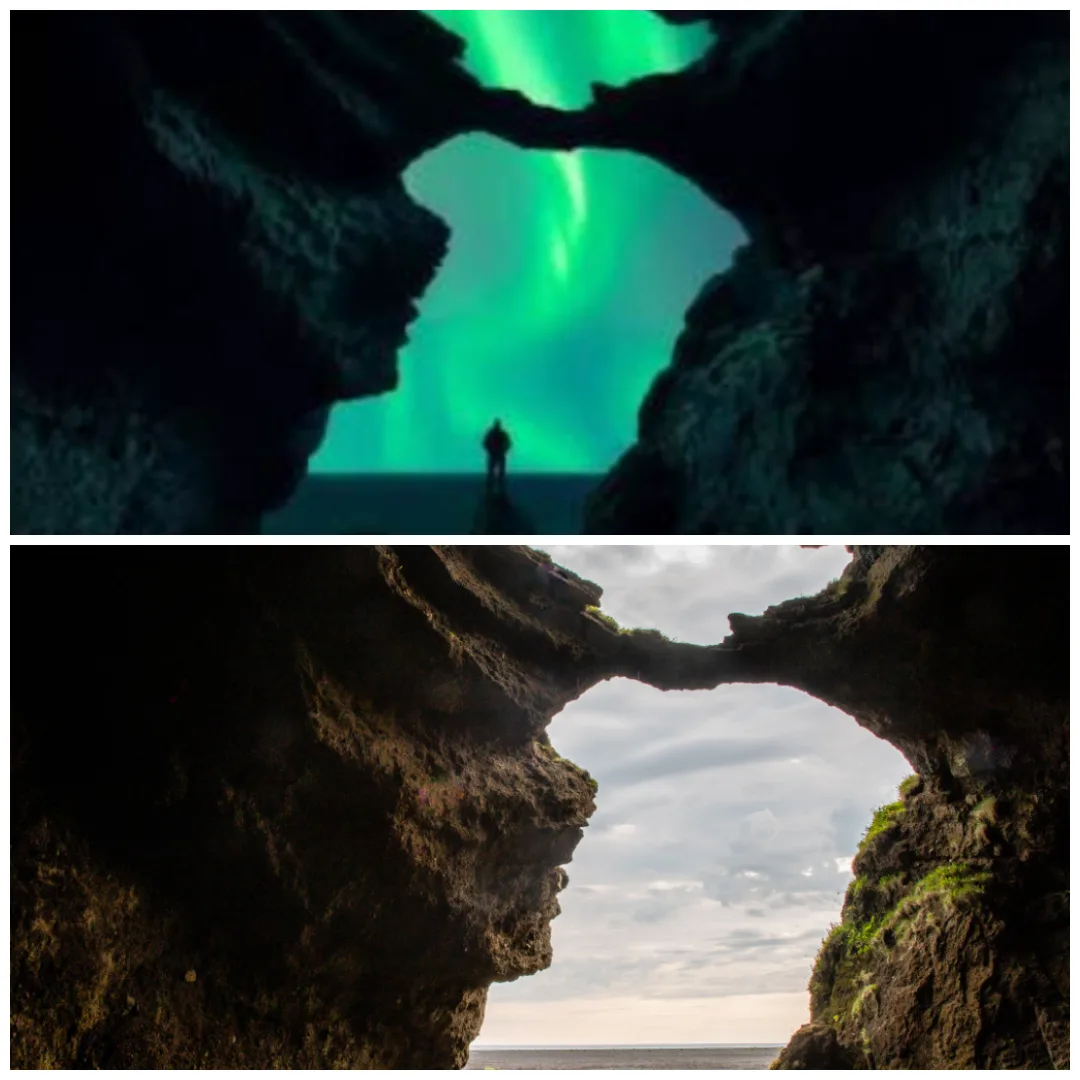
Snæfellsnes Peninsula, the Markarfljót river area, Landeyjahöfn harbour
The Iceland unit also worked around the Snæfellsnes Peninsula, the Markarfljót river area, Landeyjahöfn harbour and parts of the Icelandic Highlands. These sites broadened the film’s coastal and maritime geography, although Universal has not issued a complete shot-by-shot guide assigning every Icelandic landscape to a particular island in the narrative.
Landeyjahöfn offered a practical harbor for marine work and the movement of the production’s large ship. Markarfljót supplied river plains and eroded terrain unlike the Mediterranean coasts used elsewhere. Snæfellsnes contributed cliffs, volcanic formations and distant mountain profiles that can move easily between the real and mythological worlds.
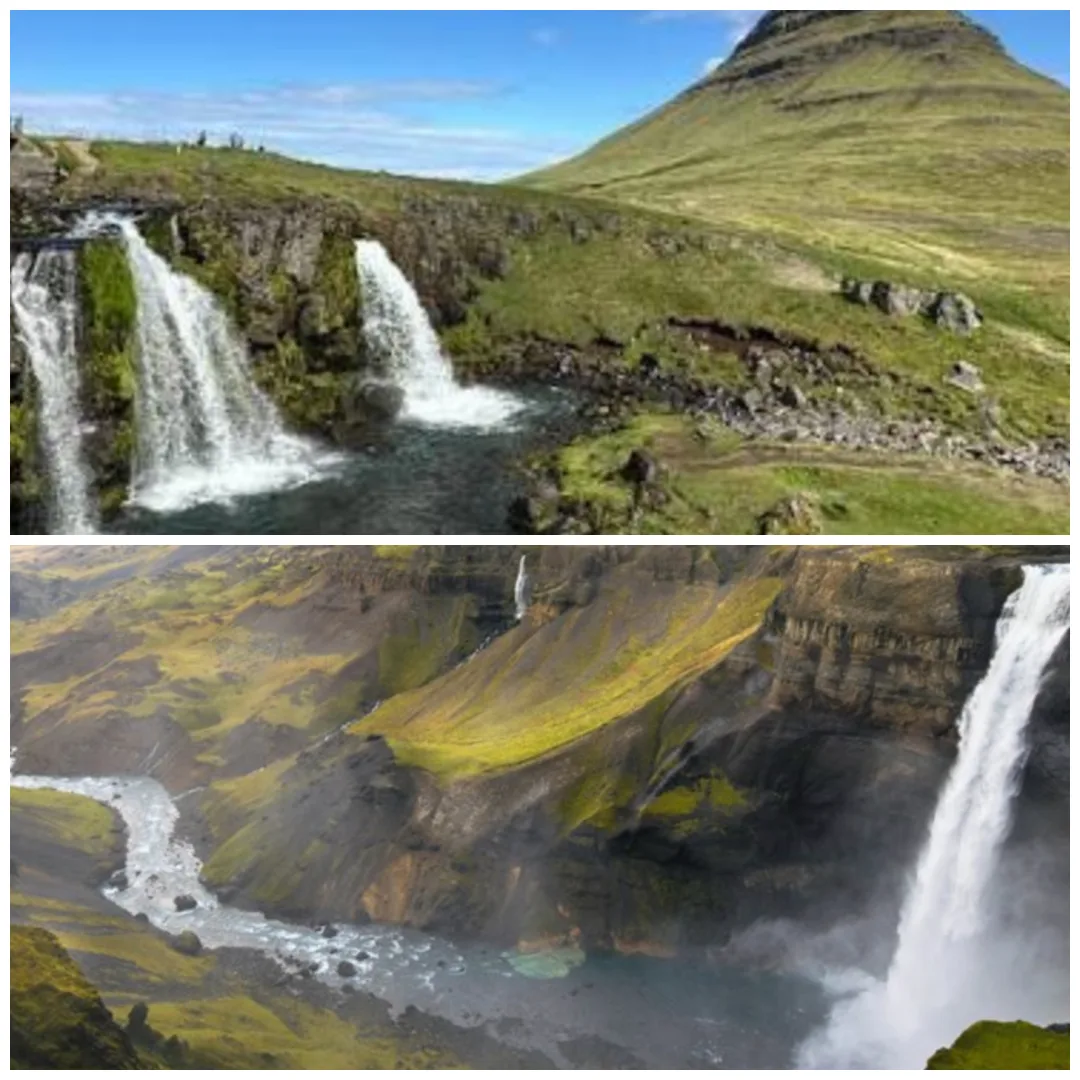
A separate Icelandic coast became what De Jong called “Apollo’s beach,” the setting connected to the sacred cattle. Despite appearing sun-bleached and pastoral, it was filmed several hours from the black Hades shoreline. The art department sourced horned cattle in Iceland to achieve the required ancient Mediterranean silhouette. The precise beach name has not been publicly disclosed.
United Kingdom
Moray coast in northern Scotland
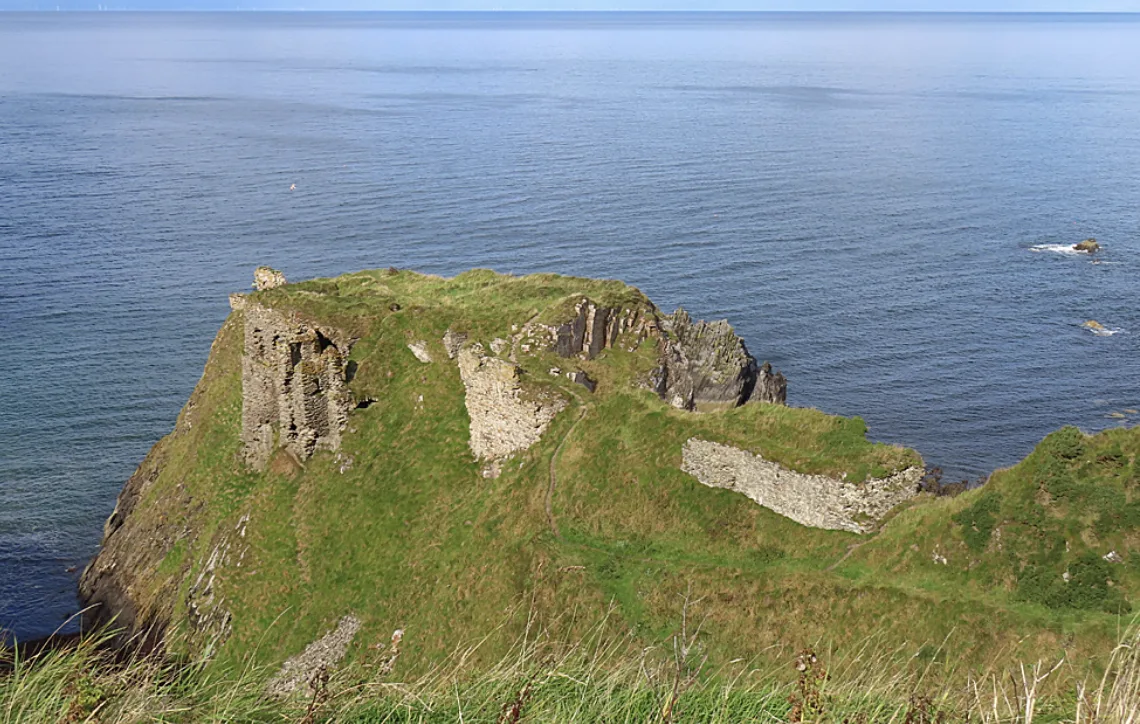
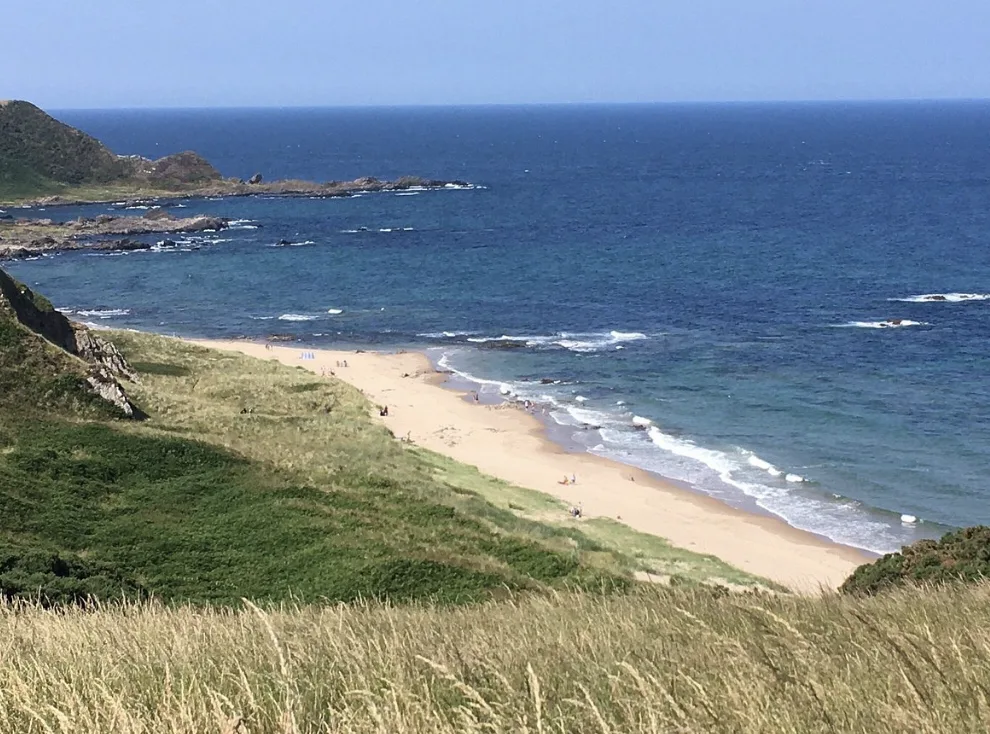
Circe’s island of Aeaea was created along the Moray coast in northern Scotland. The most distinctive location lies near Findlater Castle, east of Cullen, where the remains of a fortress cling to a cliff above the sea.
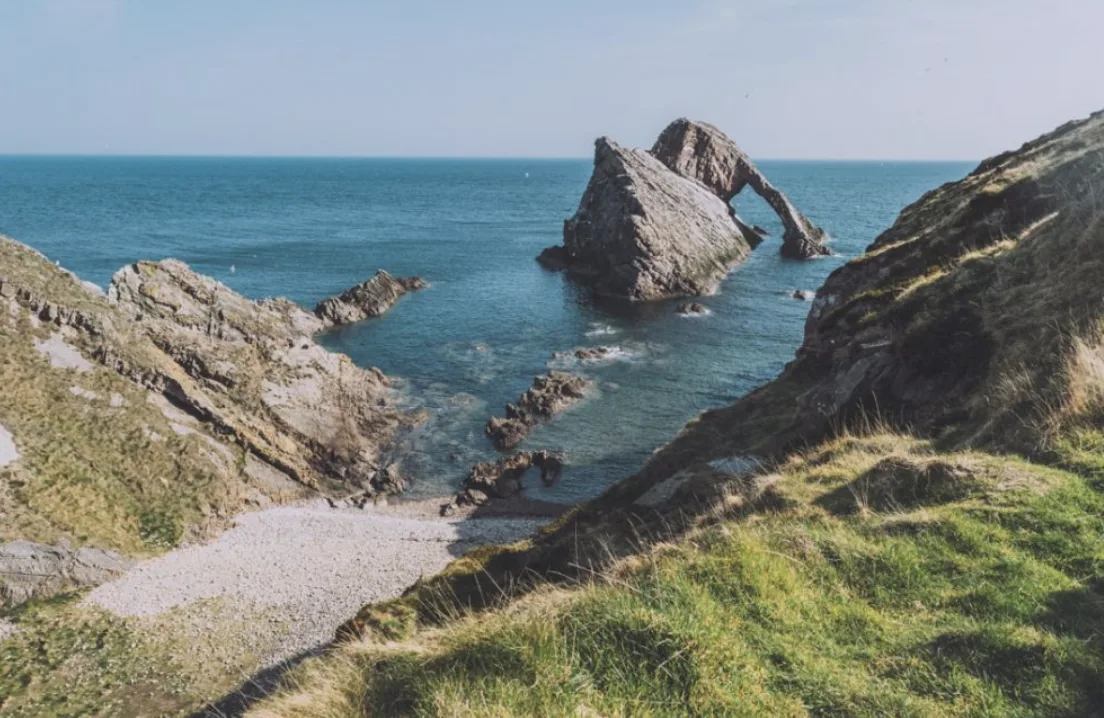
Other Scottish Locations
Moray Council confirms four principal Scottish screen locations: Findlater Castle, Sunnyside Beach, Culbin Forest and Culbin Sands. The council also identifies Buckie and Burghead harbours as important production-support bases.
Sunnyside Beach, near Cullen, provided additional coastal material associated with arrivals and movement through Aeaea. Its enclosed shore and dark rock create a transition between the open sea and Circe’s more protected inland world.
Farther west, Culbin Forest and Culbin Sands offered a very different landscape. Pine woodland grows beside dunes and tidal flats, allowing the camera to move from dense forest to an exposed shore without leaving the region.
United States
What Was Built in Los Angeles?
Los Angeles was not an incidental post-production stop. It was the sixth principal filming country in De Jong’s production account and supplied some of the movie’s largest controlled environments. The central build was the Ithacan palace interior on the Universal lot. Its multiple floors and extended central hall gave Nolan the freedom to photograph crowds and action in depth while preserving a coherent relationship between doorways, galleries and the main gathering space. The palace scenes could therefore unfold as sustained physical movement rather than a collection of small sets joined entirely through editing.
Universal’s Falls Lake, a large backlot water facility, supported controlled marine photography, inserts and work that would have been unsafe or inefficient in open water. Reports associate the tank with ship material and later controlled sequences, complementing rather than replacing the extensive photography carried out at sea.
Malta
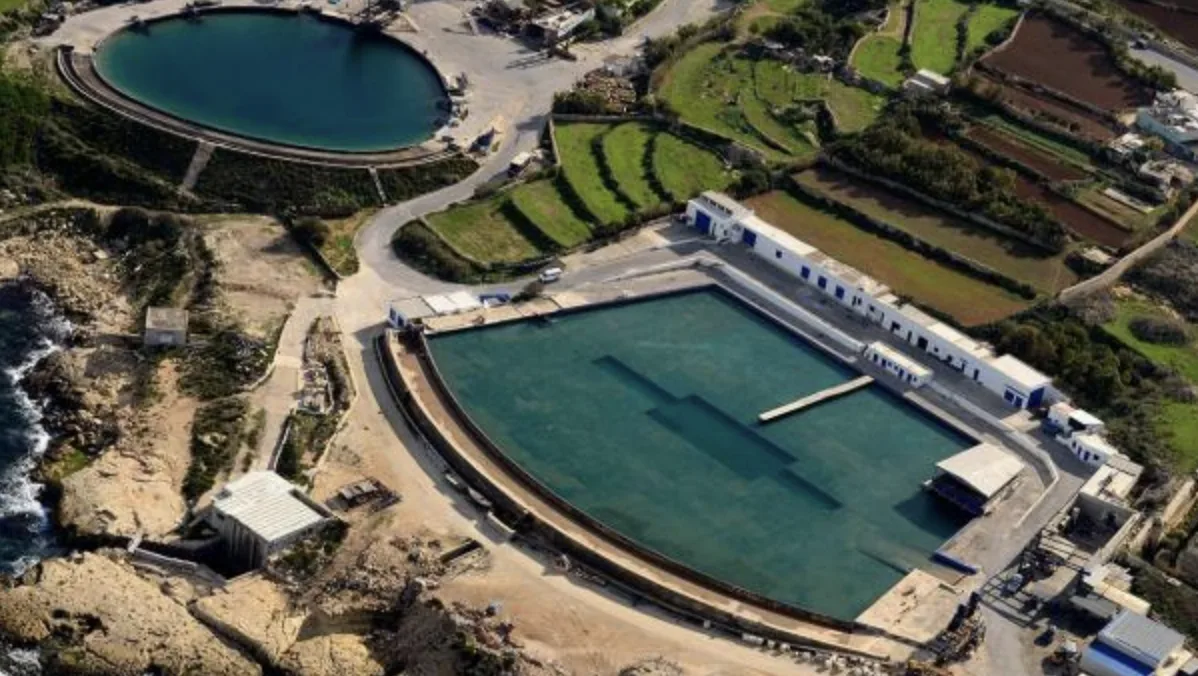
Malta occupies an uncertain position in the production record. Some detailed location reporting identifies Mediterranean Film Studios in Kalkara, known for its large exterior water tanks, as the site of underwater photography, shipwreck material and close-range sea action.
That work is plausible and has been repeatedly reported, but Malta does not appear in De Jong’s list of the six countries covered during the 91-day principal shoot. The most accurate description is that Kalkara reportedly supported specialist tank photography, potentially as a supplementary unit, rather than treating Malta as one of the principal dramatic-location countries.
Claims involving Calypso’s Cave on Gozo are weaker. Several location roundups have named the traditional mythological site, but the production designer’s own account places Calypso’s home on Morocco’s remote coast, and post-release comparisons identify Dune Blanche near Dakhla as Ogygia. No equally strong production source has explained what, if anything, was photographed at the Gozo cave.
For that reason, Calypso’s Cave should be described as reported but unconfirmed, not as an established filming location. Its traditional association with Homer’s story may have encouraged some articles to convert a thematic connection into a production claim.
Norway
Norway supplied one of the film’s most important physical assets, but the evidence does not establish it as a principal filming country.
The production sourced a 115-foot, ocean-capable wooden vessel from Stavanger and modified it to resemble an ancient Greek warship. Its robust construction allowed Nolan to place actors and crew on real water in substantial swells rather than limiting the journey to a stationary deck surrounded by screens. The ship later moved between production units, including Scotland and Morocco.
Because the vessel originated in Norway, some lists describe the country as a filming location. That conclusion goes beyond the available evidence. Until a Norwegian scene or unit schedule is documented, Stavanger is best identified as the source and preparation point for the hero ship, not a confirmed on-screen destination.
When Was ‘The Odyssey’ Filmed?
The international campaign extended from early 2025 into August, although the production completed 91 actual shooting days and reportedly finished nine days ahead of its planned camera schedule.
Morocco hosted the opening phase in February. The Greek authorities approved work during March and April, while the Italian unit spent roughly seven weeks around Favignana and the Aeolian Islands in spring. Iceland followed in June, with Scottish coastal work taking place during the broader summer campaign. The production returned to Italy for the Ostia port material from August 4 to August 8.
That calendar explains why the film’s environments feel genuinely distinct. They were not photographed during one uniform season and adjusted later to suggest changing climates. The production encountered Moroccan heat, Mediterranean sun, Icelandic cold and wind on Scotland’s northern coast as real working conditions.