Where was Conclave filmed?
Where Conclave (2024) was actually filmed: Vatican banned cameras, so director Berger assembled the papal compound from 12 locations across Rome and Caserta.
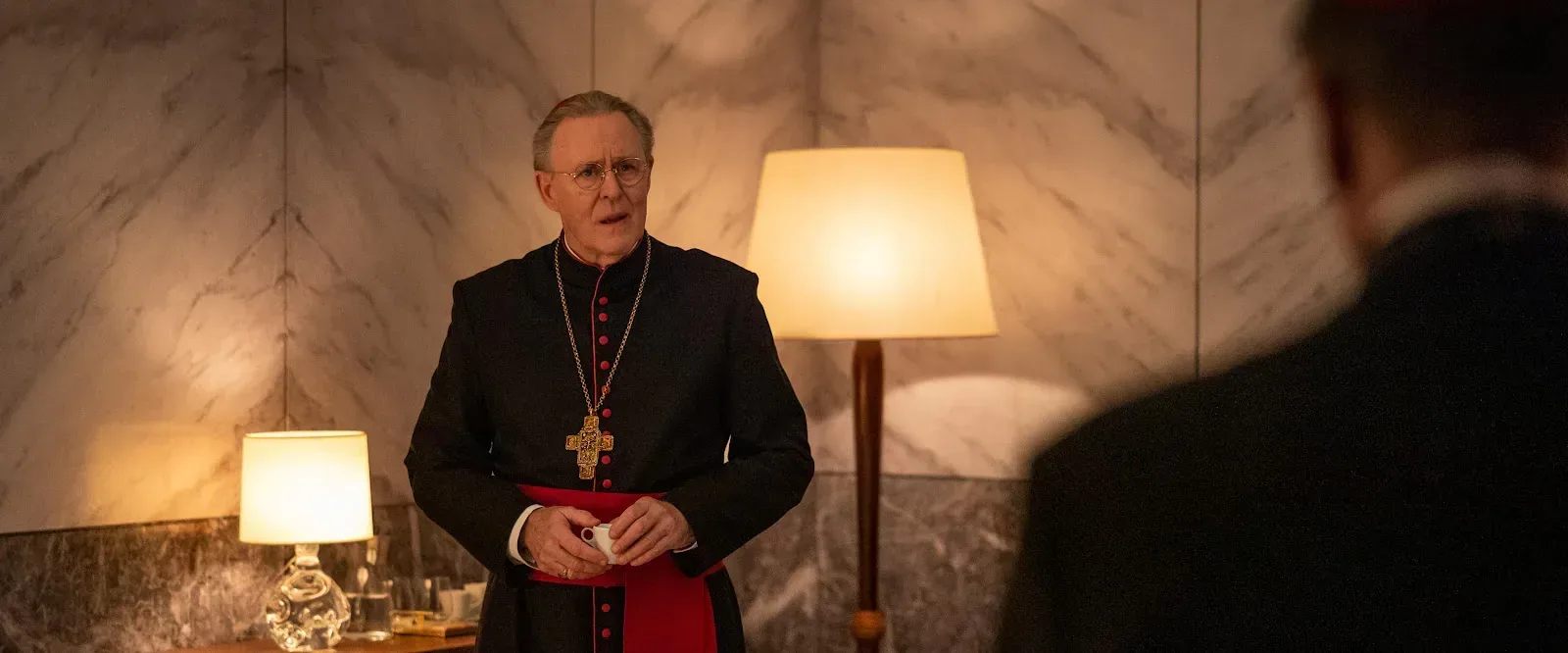
The 2024 film “Conclave,” directed by Edward Berger and starring Ralph Fiennes as Cardinal Thomas Lawrence, is set inside Vatican City but was not filmed there. Vatican policy prohibits professional filming on its grounds. The entire papal compound was reconstructed from more than a dozen separate locations across Rome and Caserta, each supplying a different room or corridor, assembled in editing to appear continuous. Filming ran from January through March 2023.
Why Filming Inside Vatican City Was Not an Option
Vatican authorities maintain a standing prohibition on professional film production anywhere on their grounds, including the Sistine Chapel and the Domus Sanctae Marthae, the guesthouse where cardinals are sequestered during an actual conclave. Director Edward Berger described the hard boundary to The Wrap: “There’s a big line on St Peter’s Square. And what that line means [is] beyond this point, no cameras, so everything else you have to imagine and piece together.” Many other desirable Roman locations were also closed to the production: Berger noted that numerous prime addresses were Church-owned, and their administrators were unlikely to grant access to a film that portrays the Catholic institution critically. “Every room was shot in a different place, just to try to piece together the overall impression of the Vatican,” he said.
The production did receive a private research visit to Vatican City. Screenwriter Peter Straughan told USA Today that Vatican staff were “quite welcoming, actually,” though that access did not extend to cameras.
Cinecittà Studios: The Sistine Chapel and the Cardinalate Corridors
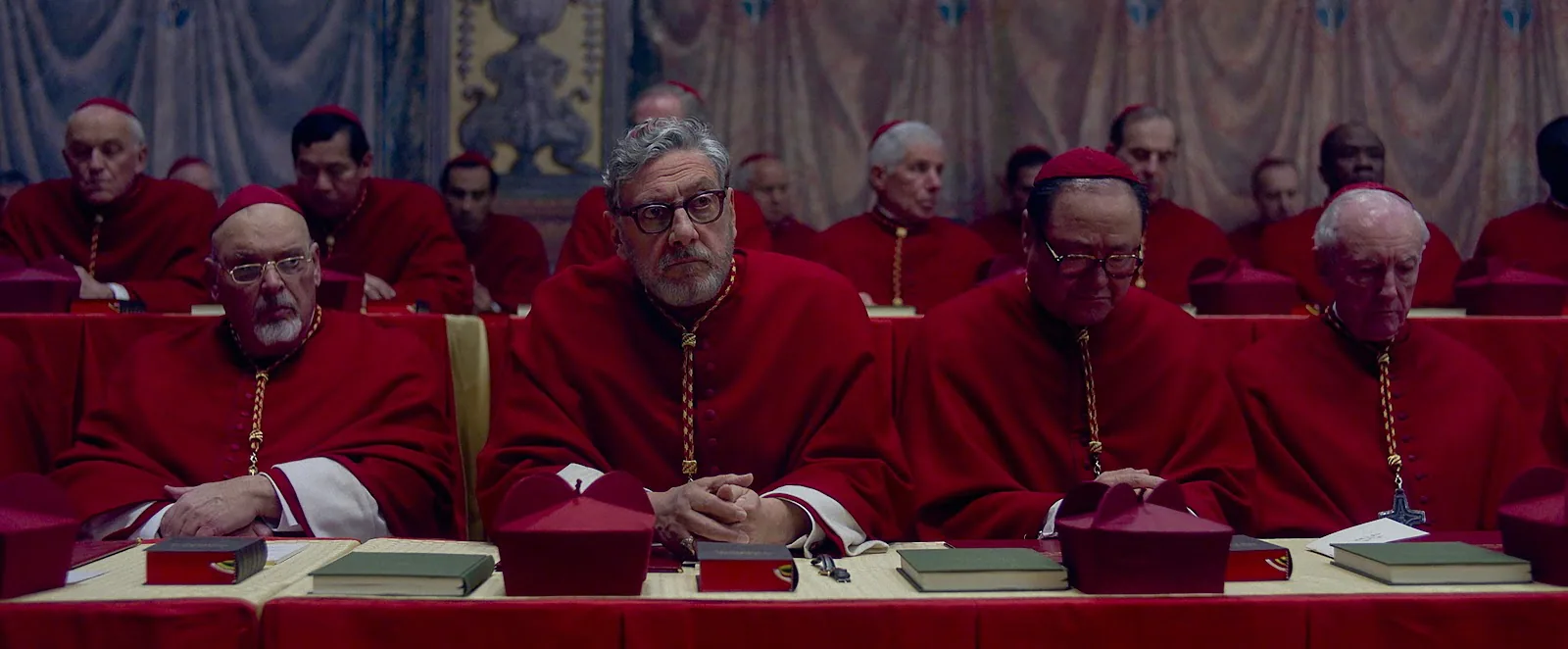
The anchor of the production was Cinecittà Studios on the Via Tuscolana in Rome, the studio complex founded in the 1930s that has housed productions from Federico Fellini to Ridley Scott. Production designer Suzie Davies discovered that Cinecittà already had an old Sistine Chapel set in storage, dismantled into eight-by-four-foot flat panels from an earlier production. Her crew rebuilt and repainted it in ten weeks. “The painting crew was extraordinary, and we put the Sistine Chapel together again in 10 weeks,” Davies told Variety. The reassembled set reaches about ten meters, with digital extensions completing the upper portion of the chapel.
Davies made deliberate departures from the real chapel’s layout. Filming the conclave ballot sequence required the cardinals to face each other across the floor, which the actual Sistine Chapel’s narrow configuration does not permit. She also replaced the floor covering from traditional beige to red carpet, describing it in an interview with The Credits as an homage to Ingmar Bergman’s “Cries and Whispers.”
The sequestered corridors of the Domus Sanctae Marthae were built entirely on a Cinecittà stage. No existing Roman building matched the required scale. Davies told The Credits she modeled the corridor aesthetic on the spare geometry of Italian architect Carlo Scarpa, stripping out ornamental moldings to give the cardinals’ quarters a deliberately institutional, airless quality. The build employed roughly 100 local Italian plasterers, painters, and set decorators over a six-month construction period.
Rome’s Public Buildings and an Abandoned Hospital
Five Rome locations each supply a distinct Vatican space.
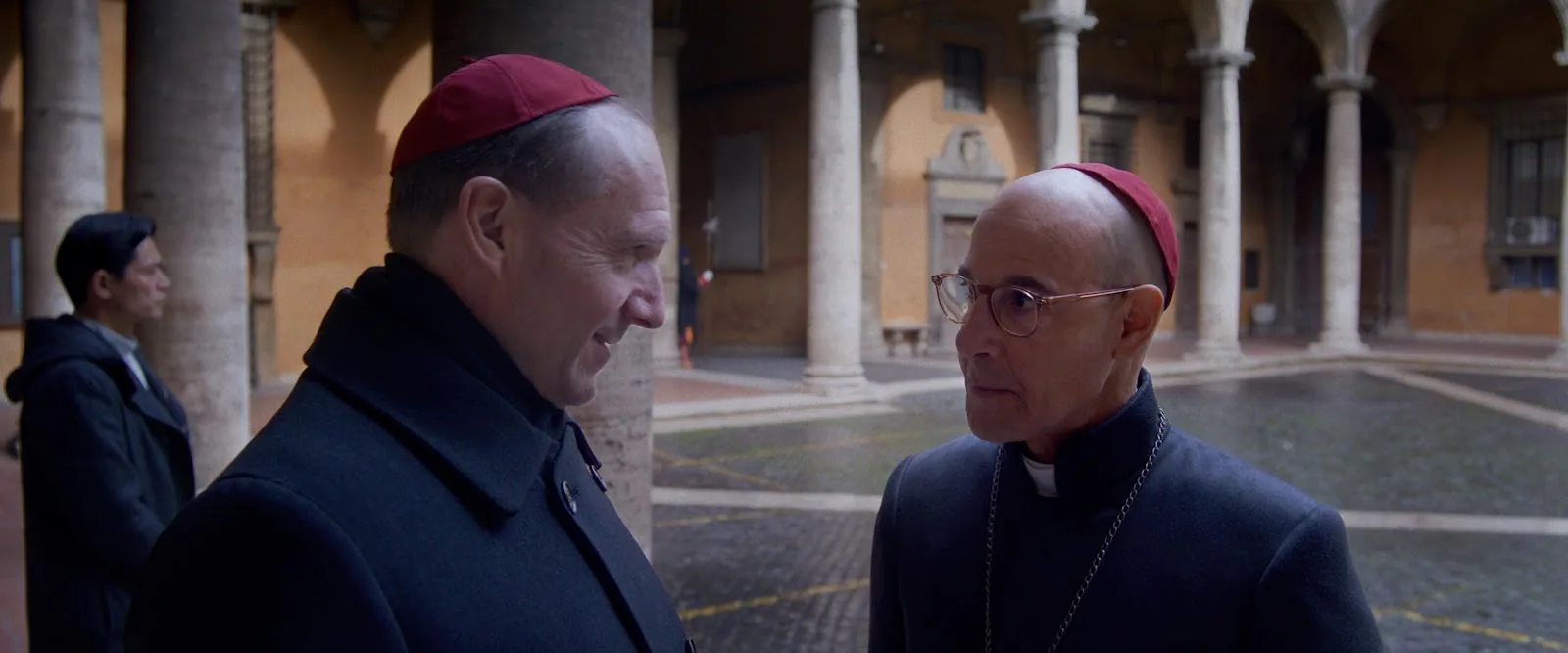
The arched courtyard through which the cardinals arrive, and where some take cigarette breaks between ballots, is the Palazzo del Commendatore at Borgo Santo Spirito 3. It is a sixteenth-century extension of the Arcispedale di Santo Spirito, a hospital complex that now operates as a conference center in the Borgo district directly east of the Vatican. The Palazzo dei Congressi in EUR served two purposes. Located at Piazza John Kennedy, it provided the auditorium where the cardinals hold formal debates and interior staircase shots that read as the Domus Sanctae Marthae.
The Palazzo Barberini on Via delle Quattro Fontane supplied the gilded hall for Lawrence’s formal welcoming address to the assembled college, with the Gold Room’s silk wallpaper also visible in the choral homily sequence preceding that address. It was built for the Barberini family after Maffeo Barberini became Pope Urban VIII in 1623, commissioned by him for his nephews and completed in 1633. The Museo della Civiltà Romana in the EUR district, closed to the public for renovation since 2014, contributed its white-pillared exterior colonnade for shots representing Vatican grounds.
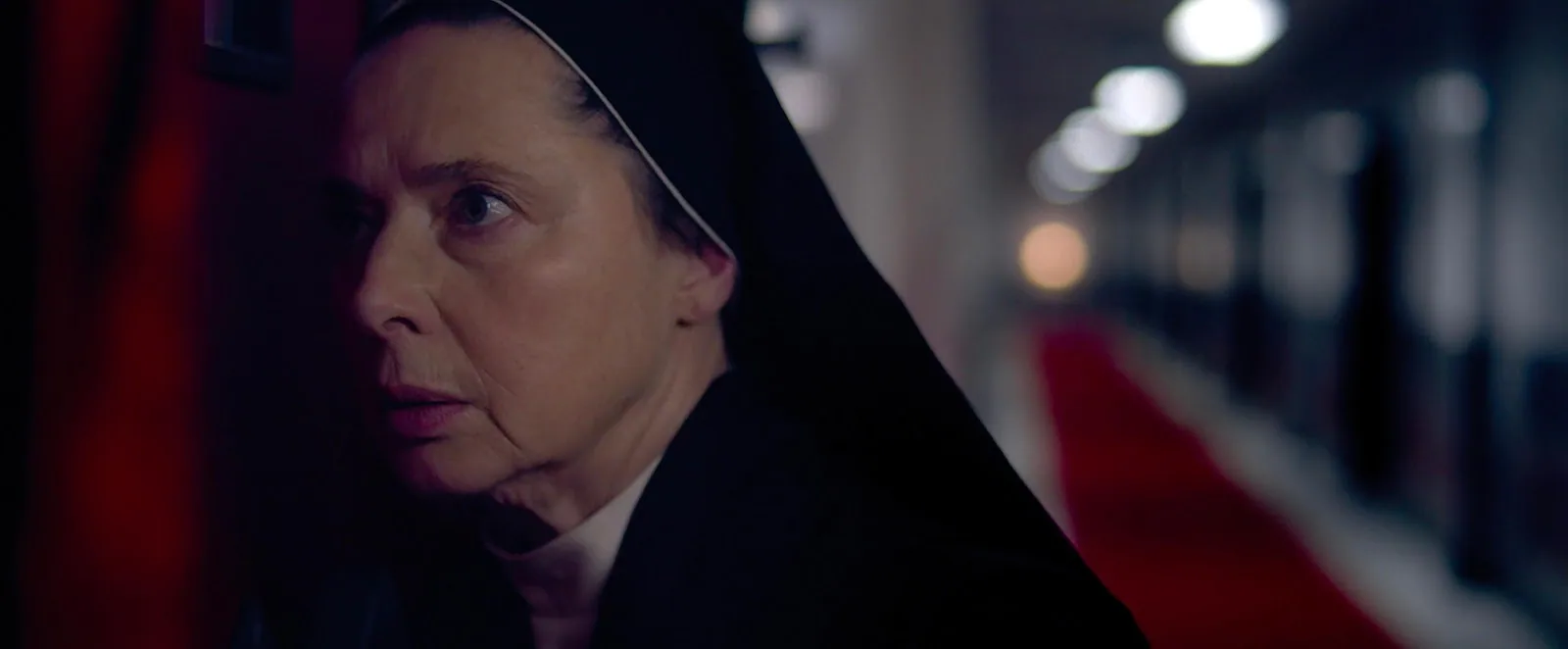
The sisters’ arrival sequence, where Cardinal Lawrence stands alone as the gates close on the outside world, was filmed in the atrium of the Carlo Forlanini Hospital at Piazza Carlo Forlanini. The tuberculosis sanatorium opened in 1934 and closed in 2015; since being declared unavailable for sale in 2017 it has been used as a location for several Italian productions.
The Vatican Garden Scenes
The exterior garden sequences were filmed across two Rome locations. The Villa Medici on the Pincian Hill, which serves today as the French Academy in Rome, provided a mosaic pond and garden terraces with city views. Production designer Davies chose it because it had “elements that had an essence of the Vatican gardens, a similar style, and some amazing views of Rome,” she told Galerie Magazine. Turtle pond scenes, including one in which Cardinal Lawrence retrieves an escaped turtle, were filmed at the villa’s mosaic pond. Ralph Fiennes told Galerie Magazine of the location: “To the person who knows, this is not the Vatican. But I think for a film, you could believe this was an aspect of the Vatican.” Because Villa Medici operates as a working museum and was undergoing restoration at the time, the crew hid scaffolding behind hedges and worked primarily at night.
The Museo Nazionale Etrusco di Villa Giulia at Piazzale di Villa Giulia 9 provided additional garden footage, including the path where Cardinal Bellini (Stanley Tucci) presses Lawrence to accept votes rather than let the traditionalist Cardinal Tedesco (Sergio Castellitto) win.
The Royal Palace of Caserta
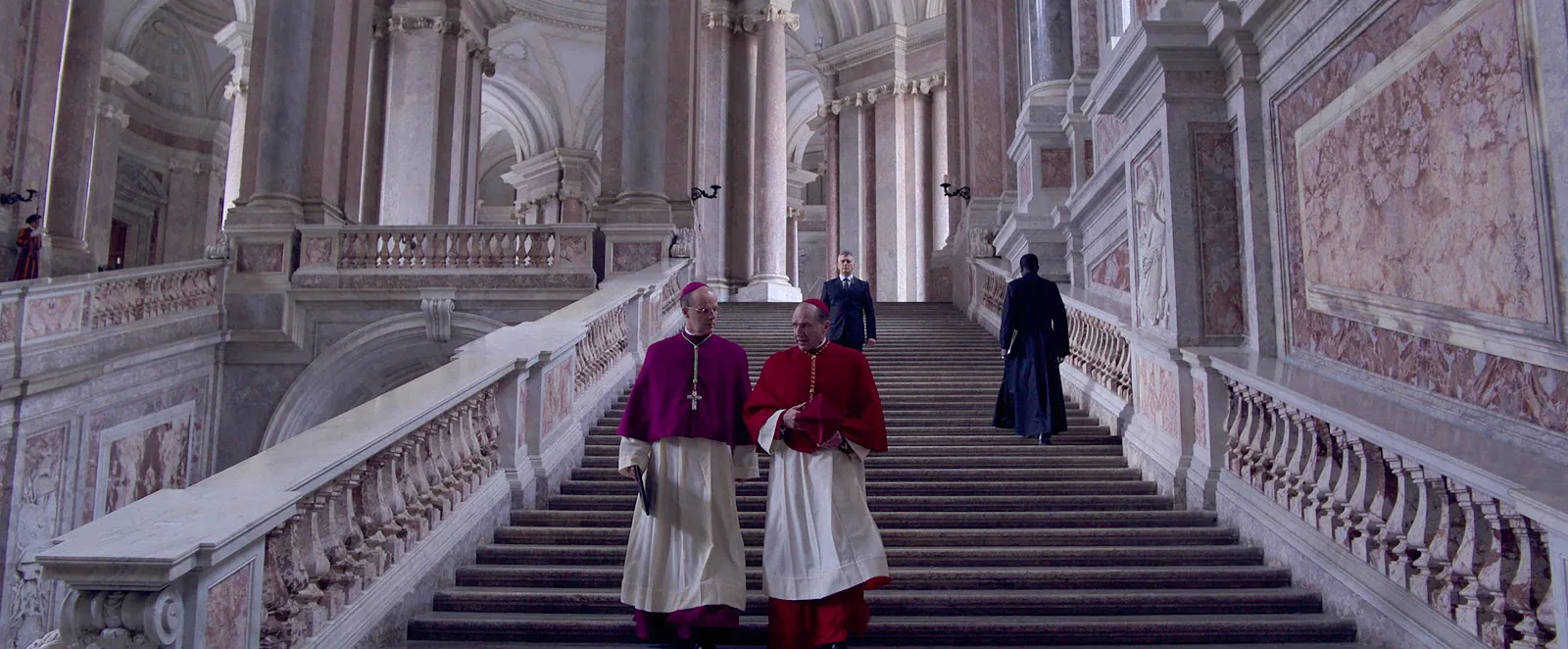
The sweeping marble entrance halls and broad ceremonial staircases that the film presents as the Vatican interior were filmed at the Royal Palace of Caserta, roughly twenty-two miles (35 kilometres) north of Naples. Commissioned by King Charles of Bourbon and designed by architect Luigi Vanvitelli in the eighteenth century, the palace is the largest royal residence in Italy by volume. The same building has stood in for Vatican-adjacent spaces before, in Ron Howard’s “Angels and Demons” (2009). A separate Caserta interior supplies the marble floor across which a turtle walks in a later scene.
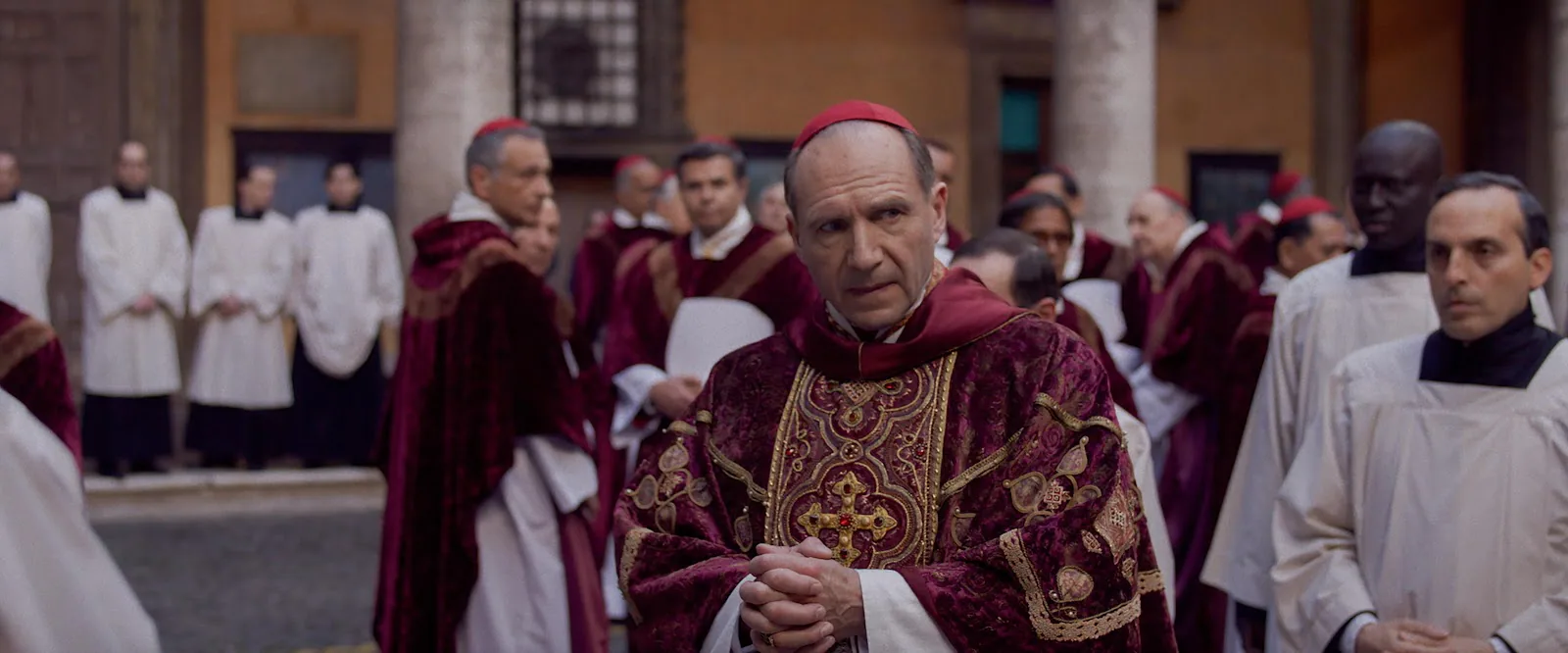
The locations collectively cut across layers of Italian institutional history: a seventeenth-century papal family palazzo, an EUR exhibition hall shuttered for more than a decade, a tuberculosis sanatorium sealed since 2015, a French cultural academy on a Roman hill, and a Bourbon royal palace in Campania. Peter Straughan’s screenplay won the Academy Award for Best Adapted Screenplay at the 2025 Oscars. The award went to a film whose most recognizable interior, the Sistine Chapel, was assembled in ten weeks from panels in a Roman storage room and has never existed in the form it appears on screen.